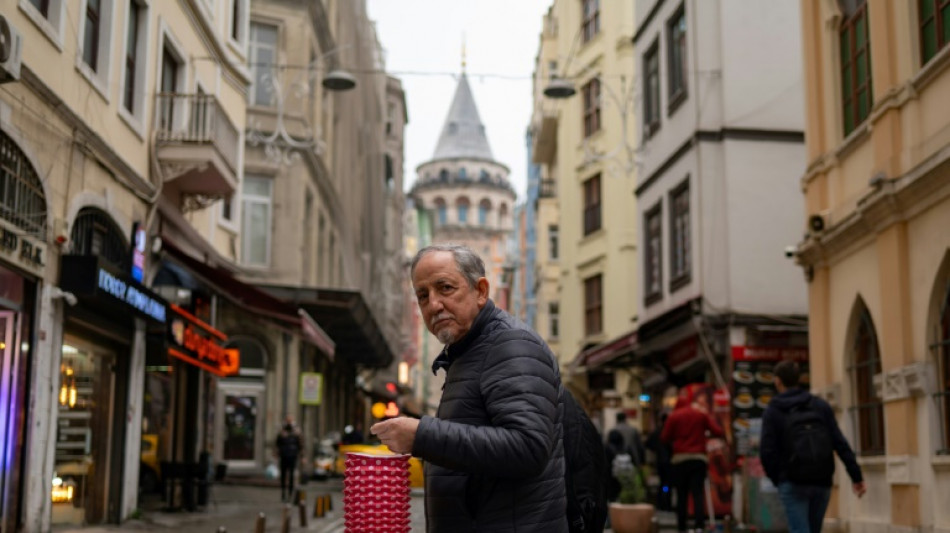
Netflix series helps heal wounds of Turkey's Jews

 Kenya's economy faces climate change risks: World Bank

 Crypto firm Tether bids for Juventus, is quickly rebuffed

 Can Venezuela survive US targeting its oil tankers?

 World stocks retrench, consolidating Fed-fuelled gains

 World stocks consolidate Fed-fuelled gains

 Stocks rally in wake of Fed rate cut

 British porn star to be deported from Bali after small fine

 Spain opens doors to descendants of Franco-era exiles

 Thai teacher finds 'peace amidst chaos' painting bunker murals

 South Korea exam chief quits over complaints of too-hard tests

 South Korea exam chief resigns after tests dubbed too hard

 Laughing about science more important than ever: Ig Nobel founder

 Crypto mogul Do Kwon sentenced to 15 years for fraud: US media

 Make your own Mickey Mouse clip - Disney embraces AI

 Dark, wet, choppy: Machado's secret sea escape from Venezuela

 2024 Eurovision winner Nemo returns trophy over Israel's participation

 Make your own AI Mickey Mouse - Disney embraces new tech

 Floodworks on Athens 'oasis' a tough sell among locals

 German growth forecasts slashed, Merz under pressure

 ECB proposes simplifying rules for banks

 Desert dunes beckon for Afghanistan's 4x4 fans

 Chocolate prices high before Christmas despite cocoa fall

 Asian traders cheer US rate cut but gains tempered by outlook

 Oracle shares dive as revenue misses forecasts

 Divided US Fed makes third straight rate cut, signals higher bar ahead

A groundbreaking Netflix series set among Turkey's Jews has been an unexpected hit there, challenging taboos and enthralling audiences with its glimpse into a long-overlooked community.
The global success of Turkish television series -- often with government-pleasing narratives -- has made the country a small-screen superpower.
But "The Club" and its sumptuous recreation of 1950s Istanbul is a first, not least because some of the dialogue is in Ladino, the language of Istanbul's Jews which derives from medieval Spanish.
While minorities once flourished in the cosmopolitan capital of the Ottoman Empire, they suffered persecution as it fell and discrimination ever since.
Jews have generally kept their heads down to protect themselves, sticking to the Turkish Jewish custom of "kayades", meaning "silence" in Ladino.
But "The Club" -- which is set around a nightclub in Istanbul's historic European quarter -- puts an end to that silence.
- Pogrom against minorities -
The attacks and persecution that drove many Jews, Greeks and Armenians to leave Turkey in the 20th century are dealt with, including a crippling 1942 tax on non-Muslims and a pogrom against Greeks in 1955 which also unleashed violence against all the other minorities.
"Silence has neither protected us from anti-Semitism nor prevented migration to other countries," said Nesi Altaras, editor of Avlaremoz online magazine run by young Turkish Jews.
"We need to talk, including on political issues that previous generations wanted to avoid," he told AFP.
Less than 15,000 Jews remain in Turkey, down from 200,000 at the beginning of the 20th century.
The majority are Sephardic, whose ancestors fled to the Ottoman Empire after they were expelled from Spain in 1492.
In a rare case of life imitating art, "The Club" became Netflix's number one show in Turkey just as Ankara tried to repair ties with Israel.
While both countries have been historically close, relations have soured badly over Israel's treatment of the Palestinians and remarks by the Turkish president criticised as anti-Semitic.
Indeed until recently, Turkish pro-government dailies regularly published stories seen to be anti-Semitic.
But Israeli President Isaac Herzog made a landmark visit to Turkey earlier this month, where he held talks with his opposite number, Recep Tayyip Erdogan.
Herzog even visited the Istanbul district in which "The Club" is set.
- Fierce debate -
The show -- and particularly the scenes of the pogroms on Istanbul's Istiklal Avenue in September 1955 when mobs lynched minorities and ransacked their shops -- has also sparked a fierce debate in the Turkish media and online about the need to confront history.
"No other TV show featured the anti-Semitic incidents of this period in such a remarkable way," said Silvyo Ovadya, president of the Jewish Museum of Turkey.
"We don't teach this part of history in schools in Turkey. Many Turks have learnt it thanks to the series," Altaras said.
"The series invites us to question the official narrative and ask ourselves, 'What happened to the Jews of Turkey?'" said Pinar Kilavuz, a researcher on Sephardic Jews at Paris-Sorbonne University.
Altaras believes the series has influenced domestic Turkish politics.
"It is no coincidence that the leader of the main opposition party has just included 'healing the wounds of the past' in his campaign, referring to the attacks against minorities," he said.
- 'We're part of this country' -
For Izzet Bana, a musician and an advisor to the series, the show accomplished a "miracle" by recreating the Jewish quarter of his childhood.
"I was worried at first because other shows caricatured Jews. But the series reflects real characters, far from cliches," Bana said.
Despite this progress on screen, Kilavuz said, more needs to be done for Turkey's Jews to feel equal.
"There is a myth about the Ottoman Empire welcoming Jews expelled from Spain in the 15th century," she said.
"It is used to stigmatise anyone asking for equal rights as showing ingratitude," she argued.
Even if everyone is considered equal before the law in Turkey, in practice non-Muslim minorities face huge obstacles, from getting government jobs to opening or repairing churches or synagogues.
It is also rare to find a senior minority figure in government or in state institutions where Sunni Turkish Muslims still dominate.
For Altaras, the series, which is due to come back with a third season, shows Turkish society that Jews were part of "the story of this country".
"We already knew that, but it's good that the Turks realise it too."
S.F.Lacroix--CPN