Three, two, one: astronomers predict SpaceX space junk will hit the Moon

 Kenya's economy faces climate change risks: World Bank

 'Stop the slaughter': French farmers block roads over cow disease cull

 Why SpaceX IPO plan is generating so much buzz

 World stocks mostly slide, consolidating Fed-fuelled gains

 UK's king shares 'good news' that cancer treatment will be reduced in 2026

 Salah admired from afar in his Egypt home village as club tensions swirl

 Iran frees child bride sentenced to death over husband's killing: activists

 France updates net-zero plan, with fossil fuel phaseout

 EU agrees recycled plastic targets for cars

 British porn star fined, faces imminent Bali deportation

 Indonesia floods were 'extinction level' for rare orangutans

 Japan bear victim's watch shows last movements

 French indie 'Clair Obscur' dominates Game Awards

 Asian markets track Wall St record after Fed cut

 Vaccines do not cause autism: WHO

 'In her prime': Rare blooming of palm trees in Rio

 OpenAI beefs up GPT models in AI race with Google

 Cyclone causes blackout, flight chaos in Brazil's Sao Paulo

 US bringing seized tanker to port, as Venezuela war threats build

 Time magazine names 'Architects of AI' as Person of the Year

 OpenAI, Disney to let fans create AI videos in landmark deal

 Thyssenkrupp pauses steel production at two sites citing Asian pressure

 Stocks mixed as US rate cut offset by Fed outlook, Oracle earnings

 Breakout star: teenage B-girl on mission to show China is cool

 Austria set to vote on headscarf ban in schools

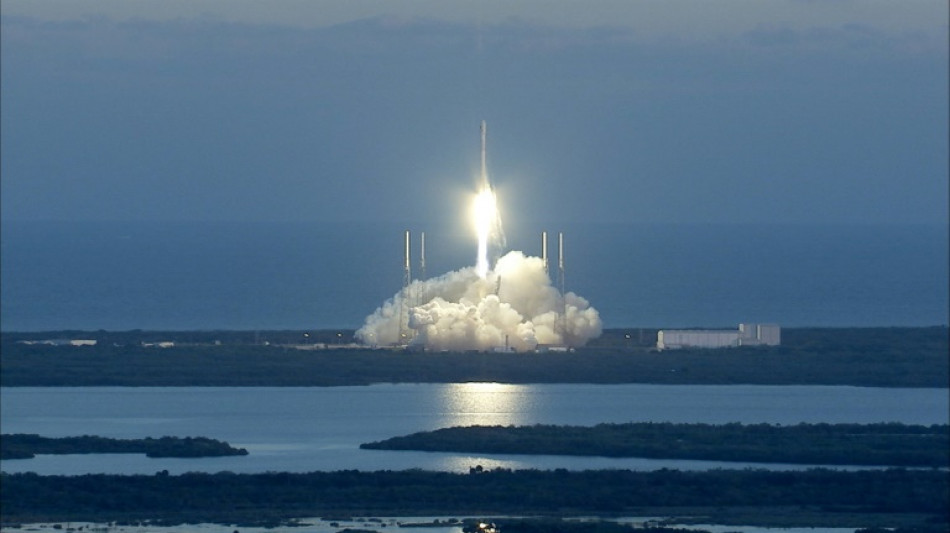
A chunk of a SpaceX rocket that blasted off seven years ago and was abandoned in space after completing its mission will crash into the Moon in March, experts say.
The rocket was employed in 2015 to put in orbit a NASA satellite called the Deep Space Climate Observatory.
Since then the second stage of the rocket, or booster, has been floating in what mathematicians call a chaotic orbit, astronomer Bill Gray told AFP Wednesday.
It was Gray who calculated the space junk's new collision course with the Moon.
The booster passed by pretty close to the Moon in January in a rendezvous that altered its orbit, said Gray.
He is behind Project Pluto, software that allows for calculating the trajectory of asteroids and other things in space and is used in NASA-financed space observation programs.
A week after the rocket stage whizzed close to the Moon, Gray detected it again and concluded it will actually crash into the satellite's dark side on March 4.
Gray appealed to the amateur astronomer community to join him in observing the booster -- it is bright and easy to detect -- and his conclusion was confirmed.
The exact time and spot of impact may change a bit from his forecast but there is widespread agreement that there will be a collision on the Moon that day.
"I've been tracking junk of this sort for about 15 years. And this is the first unintentional lunar impact that we've had," Gray told AFP.
The impact of this object weighing four tons on the Moon will not be visible from Earth in real time.
But it will leave a crater that scientists can observe, such as with NASA's Lunar Reconnaissance Orbiter or India's Chandrayaan-2 satellite, and thus learn more about the geology of the Moon.
Spacecraft have been intentionally crashed into the Moon before, for scientific purposes.
In 2009, for instance, NASA sent a rocket stage hurling into the Moon near its south pole to look for water.
But most rockets do not go so far from Earth. SpaceX brings its rocket boosters back through the Earth's atmosphere so they disintegrate over the ocean.
Gray said there could be more unintentional crashes into the Moon in the future as the US and Chinese space programs leave more junk in orbit.
A.Mykhailo--CPN