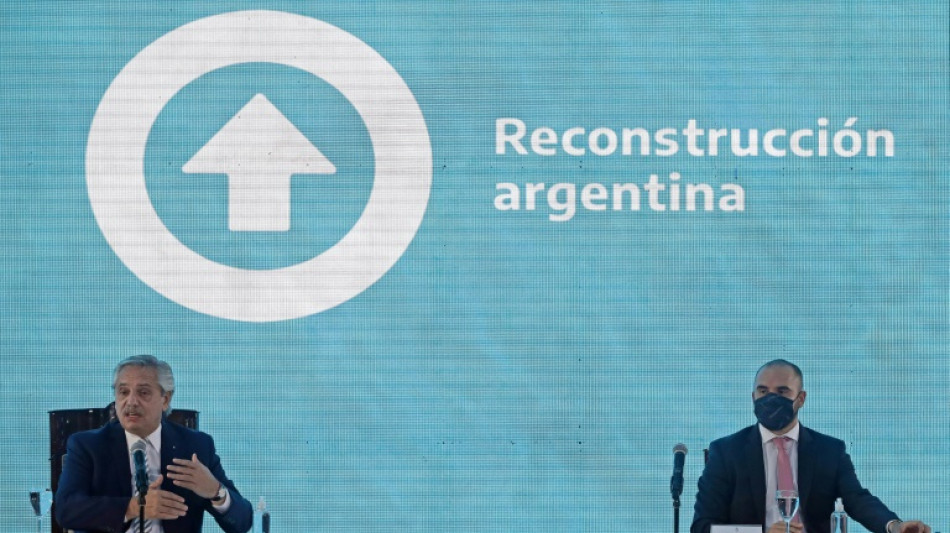
Argentina president announces new debt deal with IMF

 Kenya's economy faces climate change risks: World Bank

 Campaigning starts in Central African Republic quadruple election

 First urban cable car unveiled outside Paris

 US unseals warrant for tanker seized off Venezuelan coast

 Crypto firm Tether bids for Juventus, is quickly rebuffed

 Can Venezuela survive US targeting its oil tankers?

 World stocks retrench, consolidating Fed-fuelled gains

 World stocks consolidate Fed-fuelled gains

 Stocks rally in wake of Fed rate cut

 British porn star to be deported from Bali after small fine

 Spain opens doors to descendants of Franco-era exiles

 Thai teacher finds 'peace amidst chaos' painting bunker murals

 South Korea exam chief quits over complaints of too-hard tests

 South Korea exam chief resigns after tests dubbed too hard

 Laughing about science more important than ever: Ig Nobel founder

 Crypto mogul Do Kwon sentenced to 15 years for fraud: US media

 Make your own Mickey Mouse clip - Disney embraces AI

 Dark, wet, choppy: Machado's secret sea escape from Venezuela

 2024 Eurovision winner Nemo returns trophy over Israel's participation

 Make your own AI Mickey Mouse - Disney embraces new tech

 Floodworks on Athens 'oasis' a tough sell among locals

 German growth forecasts slashed, Merz under pressure

 ECB proposes simplifying rules for banks

 Desert dunes beckon for Afghanistan's 4x4 fans

 Chocolate prices high before Christmas despite cocoa fall

Argentine President Alberto Fernandez unveiled what he called a "reasonable" new debt repayment deal with the International Monetary Fund on Friday, the day a $700-million repayment was due.
The South American country was due this year to pay back $19 billion of its $44-billion debt to the IMF.
"Compared to previous ones Argentina signed, this deal does not include restrictions that would delay our development," said Fernandez.
Under the previous deal, Argentina would have to repay $19 billion this year, $20 billion next year and another $4 billion in 2024.
As well as Friday's sum, another $370 million needed to be paid on Tuesday.
The center-left government had repeatedly said the repayment schedule was unsustainable given their lack of reserves, and was pushing to restructure the timetable.
"We had an unpayable debt that left us without present or future, and now we have a reasonable deal that will allow us to grow (the economy) and fulfill our obligations throughout our growth," said Fernandez.
"This understanding plans to sustain the economic recovery that has already begun."
Fernandez said the deal crucially would not force the government to reduce public spending and would allow it to increase investment in public works.
Under the new deal, Argentina has committed to progressively reducing its fiscal deficit from three percent in 2021 to just 0.9 percent in 2024, Economy Minister Martin Guzman said.
The gradual reduction -- to 2.5 percent in 2022 and 1.9 percent in 2023 -- would "not prevent the recovery" of the economy, said Guzman.
It would also allow for public spending to evolve "without an adjustment."
Fernandez's liberal predecessor Mauricio Macri originally agreed a $57-billion loan with the IMF in 2018, but when his successor took office a year later, Fernandez refused to accept the final $13-billion disbursement.
After successfully restructuring a $66-billion debt with private international creditors in 2020, Argentina began negotiations with the IMF to delay repayments.
The country experienced three years of recession until registering a 10 percent increase in GDP in 2021, although the economy had shrunk by as much the previous year as it suffered the worst effects of the coronavirus pandemic.
M.P.Jacobs--CPN