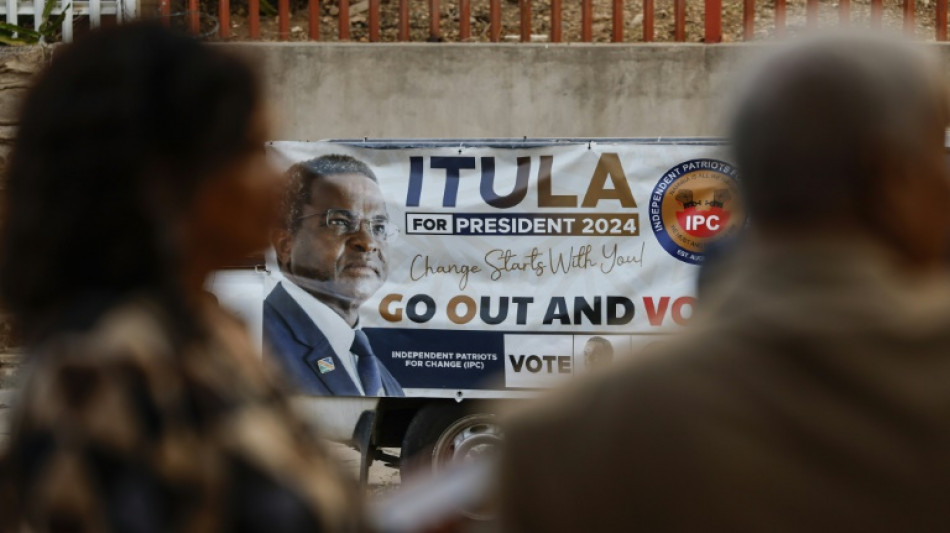
Namibians heads to the polls wanting change / Photo: SIMON MAINA - AFP

 Kenya's economy faces climate change risks: World Bank

 'Stop the slaughter': French farmers block roads over cow disease cull

 Why SpaceX IPO plan is generating so much buzz

 World stocks mostly slide, consolidating Fed-fuelled gains

 UK's king shares 'good news' that cancer treatment will be reduced in 2026

 Salah admired from afar in his Egypt home village as club tensions swirl

 Iran frees child bride sentenced to death over husband's killing: activists

 France updates net-zero plan, with fossil fuel phaseout

 EU agrees recycled plastic targets for cars

 British porn star fined, faces imminent Bali deportation

 Indonesia floods were 'extinction level' for rare orangutans

 Japan bear victim's watch shows last movements

 French indie 'Clair Obscur' dominates Game Awards

 Asian markets track Wall St record after Fed cut

 Vaccines do not cause autism: WHO

 'In her prime': Rare blooming of palm trees in Rio

 OpenAI beefs up GPT models in AI race with Google

 Cyclone causes blackout, flight chaos in Brazil's Sao Paulo

 US bringing seized tanker to port, as Venezuela war threats build

 Time magazine names 'Architects of AI' as Person of the Year

 OpenAI, Disney to let fans create AI videos in landmark deal

 Thyssenkrupp pauses steel production at two sites citing Asian pressure

 Stocks mixed as US rate cut offset by Fed outlook, Oracle earnings

 Breakout star: teenage B-girl on mission to show China is cool

 Austria set to vote on headscarf ban in schools

The mix of people milling around Windhoek's Zoo Park reflect the hopes and disappointments of Namibians who head to the polls Wednesday in a test for the party that brought independence 34 years ago but has left many feeling let down.
Employees on their lunch break and young homeless people share spots on the grass of this downtown meeting point at the corner of Independence Avenue and Fidel Castro Street.
"Change" is what many say they want to see in the southern African nation once colonised by Germany, which has left its mark in the Bavarian architecture of some of the surrounding buildings.
"We are going to vote for change, we need to improve this country, reduce poverty," said Josephina Shitotoka, a 43-year-old civil servant.
Her two daughters, aged 17 and 21, are jobless like many other young people in the desert nation of about three million people.
Unemployment among 15- to 34-year-olds is estimated at 46 percent, according to the latest official figures from 2018, which is almost triple the national average.
"There is a lot of corruption... you don't get a job if you don't know somebody at the office," Shitotoka said.
She hopes the winner of Wednesday's vote will be the candidate of the ruling South West Africa People's Organisation's (SWAPO), Netumbo Nandi-Ndaitwah, current vice president and a political veteran.
While NNN -- as the 72-year-old is known -- represents the party that has governed the nation since independence in 1990. But if elected, she would be the country's first female president and one of the few women leaders in the region.
"She is going to win and change things," said Shitotoka.
First-time voter Thabang Mosenedi, 19, doesn't want to reveal who she will vote for but also wants a break with the past.
"As long as there's change, I'm okay either way," said the student. "A lot of people are complaining that there aren't any jobs and that the government isn't doing anything to help."
- Corruption, poverty -
General discontent in the sparsely populated country may be turning part of the electorate away from SWAPO, whose founders freed the country from the apartheid-era government of neighbouring South Africa.
Mikka Joseph, a trade union representative, is among them. "I used to be a member of SWAPO but I left because of corruption in 2019," he said, referring to the year of a corruption case, dubbed the Fishrot Scandal, that implicated two former ministers.
The 43-year-old then joined the Independent Patriots for Change (IPC) party founded by the main opposition leader Panduleni Itula, 67, who worked as a dentist before turning to politics.
"We need change," Joseph said.
In addition to high unemployment, Namibia also faces skyrocketing inequality levels. It is rich in minerals but has struggled to translate that wealth into benefits for its people.
"How are the resources utilised?" asked 61-year-old retiree Bonny Tjirongo. They "should be used to benefit all Namibians... to try and eradicate poverty."
Namibia ranks as one of the world's most unequal countries, according to the World Bank.
"Namibian society's vast disparities have led to a dual economy -- a highly developed modern sector, co-existing with an informal subsistence-oriented one," it says.
Among those living on daily wages is 28-year-old Phillip Kapako, originally from Katutura township in Windhoek. These days he sleeps rough in Zoo Park and washes cars for a living.
"Look at the streets, did you see how many people are homeless?" he asked.
M.García--CPN