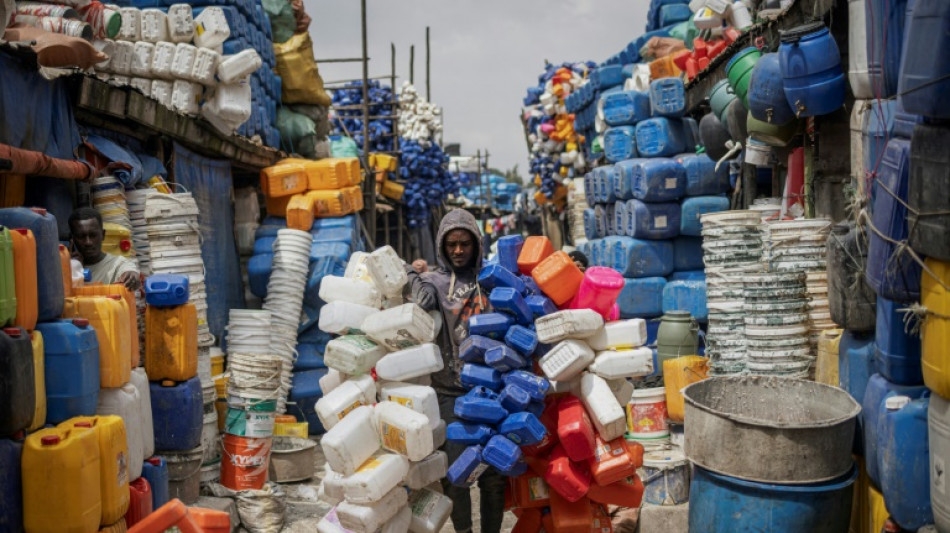
Waste pickers battle for recognition at plastic treaty talks / Photo: Michele Spatari - AFP/File

 Kenya's economy faces climate change risks: World Bank

 Crypto firm Tether bids for Juventus, is quickly rebuffed

 Can Venezuela survive US targeting its oil tankers?

 World stocks retrench, consolidating Fed-fuelled gains

 World stocks consolidate Fed-fuelled gains

 Stocks rally in wake of Fed rate cut

 British porn star to be deported from Bali after small fine

 Spain opens doors to descendants of Franco-era exiles

 Thai teacher finds 'peace amidst chaos' painting bunker murals

 South Korea exam chief quits over complaints of too-hard tests

 South Korea exam chief resigns after tests dubbed too hard

 Laughing about science more important than ever: Ig Nobel founder

 Crypto mogul Do Kwon sentenced to 15 years for fraud: US media

 Make your own Mickey Mouse clip - Disney embraces AI

 Dark, wet, choppy: Machado's secret sea escape from Venezuela

 2024 Eurovision winner Nemo returns trophy over Israel's participation

 Make your own AI Mickey Mouse - Disney embraces new tech

 Floodworks on Athens 'oasis' a tough sell among locals

 German growth forecasts slashed, Merz under pressure

 ECB proposes simplifying rules for banks

 Desert dunes beckon for Afghanistan's 4x4 fans

 Chocolate prices high before Christmas despite cocoa fall

 Asian traders cheer US rate cut but gains tempered by outlook

 Oracle shares dive as revenue misses forecasts

 Divided US Fed makes third straight rate cut, signals higher bar ahead

As diplomats negotiate behind closed doors in Busan on a treaty to curb plastic pollution, the waste pickers who are on the front lines of the problem are fighting for recognition.
Between 20 and 34 million people are believed to work as waste pickers worldwide, playing a crucial role in recovering recyclable material.
"We're the biggest business in the world," 54-year-old Maria Soledad Mella Vidal, a Chilean waste picker, told AFP.
"We don't have money, infrastructure or machinery... but we are extremely proud because our contribution to the environment is real."
Representatives of nearly 200 nations are gathered in South Korea to agree on a landmark deal to curb plastic pollution that litters the planet.
Just nine percent of plastic is currently recycled globally.
But estimates suggest over half of what is recycled is recovered by waste pickers.
Johnson Doe joined the sector at 16 in Ghana's capital Accra.
"There was no formal job around, so the only work to do was to be a waste picker," he told AFP.
Every day, the 39-year-old waits for waste trucks to arrive at one of the city's dumps so he can collect recyclable items for sale to an intermediary.
He earns three dollars a day on average, "enough to sustain myself", he said.
After more than two decades in the job, plastic no longer holds any secrets for him.
"We can tell," he said, examining a plastic bottle placed before him and rattling off the different plastic components.
"I love this job," he added. "But what we need is integration, respect and inclusion."
- 'We should be involved' -
As observers, waste pickers can sit in on negotiations, but do not have the right to participate despite their direct experience with the problem.
"If there is a discussion... we should be involved," Doe said.
Mella Vidal, the waste picker from Chile, is also an expert on plastics and wants a ban on single-use items, which is under discussion in the negotiations.
She also wants a redesign of plastic products to facilitate recycling, giving the example of the pill strip for the paracetamol she is taking to combat a cold.
"It's PS (polystyrene). It has no value in the market. And on top of that, there's a thin layer of aluminium stuck on top. It's an eco-design problem, like yoghurt pots," she said.
Mella Vidal no longer works at dump sites, which have disappeared with new rules in Chile on sanitary landfills.
Instead, she gets up at 5:00 am to scour the street for recyclables before waste trucks pass through, sorting what she finds in the courtyard of her house.
"No machine can replace the relationship between a waste picker and waste," she said.
"A nail or a piece of glass can jam a sorting machine. Nothing stops us."
In 2022, a UN resolution recognised the contribution of waste pickers to the fight against plastic pollution, and the sector wants that enshrined in any deal in Busan.
- A growing movement -
They say it would open the door to legal recognition of their work.
"A lot of people prejudge us. They think we're criminals or drug addicts," said Mella Vidal.
The profession is also dangerous, exposing workers to toxic chemicals, poorly regulated work sites and even violence.
In 1992, 11 waste pickers were killed in Colombia by security guards who planned to sell their corpses to a medical school.
A twelfth was able to escape and alert police.
The crime shocked Colombia and helped galvanise a movement.
March 1, the day the massacre was uncovered, is now International Waste Pickers Day.
About 460,000 people now belong to the International Alliance of Waste Pickers, a union whose members attend international meetings like the negotiations in Busan.
Among their demands is better health protection given the toxic substances to which they are regularly exposed.
"We are not getting support from the government or from anybody," said Doe.
"And it's because we are not mentioned in the policies. So if we have a legal treaty that mentions waste pickers, we will have support."
M.Anderson--CPN