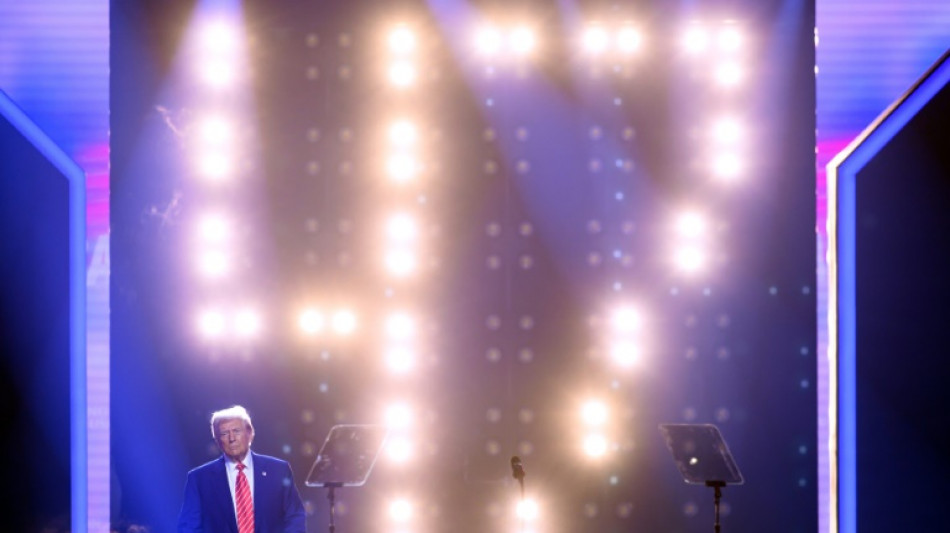
Trump's return threatens resurgence of trade wars / Photo: JOSH EDELSON - AFP/File

 Kenya's economy faces climate change risks: World Bank

 'Stop the slaughter': French farmers block roads over cow disease cull

 Why SpaceX IPO plan is generating so much buzz

 World stocks mostly slide, consolidating Fed-fuelled gains

 UK's king shares 'good news' that cancer treatment will be reduced in 2026

 Salah admired from afar in his Egypt home village as club tensions swirl

 Iran frees child bride sentenced to death over husband's killing: activists

 France updates net-zero plan, with fossil fuel phaseout

 EU agrees recycled plastic targets for cars

 British porn star fined, faces imminent Bali deportation

 Indonesia floods were 'extinction level' for rare orangutans

 Japan bear victim's watch shows last movements

 French indie 'Clair Obscur' dominates Game Awards

 Asian markets track Wall St record after Fed cut

 Vaccines do not cause autism: WHO

 'In her prime': Rare blooming of palm trees in Rio

 OpenAI beefs up GPT models in AI race with Google

 Cyclone causes blackout, flight chaos in Brazil's Sao Paulo

 US bringing seized tanker to port, as Venezuela war threats build

 Time magazine names 'Architects of AI' as Person of the Year

 OpenAI, Disney to let fans create AI videos in landmark deal

 Thyssenkrupp pauses steel production at two sites citing Asian pressure

 Stocks mixed as US rate cut offset by Fed outlook, Oracle earnings

 Breakout star: teenage B-girl on mission to show China is cool

 Austria set to vote on headscarf ban in schools

Donald Trump's second presidential term promises a return to tariffs as he pressures partners and rivals to tackle everything from migration to drug trafficking, while protecting US industries -- in moves that could trigger new trade wars.
Even before taking office, Trump has raised the prospect of fresh levies on companies, countries and groups of states as he seeks to implement his agenda.
He has vowed tariffs on Mexico, Canada and China until they crack down on fentanyl and border crossings, and he threatened "economic force" against Ottawa after suggesting Canada should become the 51st US state.
Trump also warned of 100 percent tariffs on BRICS nations -- a bloc including Brazil, Russia, India, China and South Africa -- if they create a rival to the US dollar.
New trade wars could rock the global economy, worsen tensions with Beijing and upend ties with allies.
US manufacturers, farmers and small business owners await his first moves, girding for higher import costs on anything from batteries to wines, while bracing for retaliation.
"I'm not necessarily against all tariffs," said Mark Pascal, a restaurant owner based in New Jersey.
He said he understands the rationale of taxing a country that unfairly suppresses prices.
But "we're concerned about any tariff that would apply broadly to wine and spirits, which is an industry that is not unfairly competing in any way," added Francis Schott, who co-runs restaurants with Pascal.
Trump introduced a range of duties in his first term, including on steel and aluminum, and on Chinese imports as he waged an all-out trade war on the world's second biggest economy.
In 2019, he imposed tariffs on European food and drinks as Washington and Brussels clashed over aviation subsidies.
While these were later suspended, restaurateurs worry their return would batter small establishments.
"It raised our costs, so it raised our prices," said Pascal.
- Global impact -
Trump has used tariffs as a bargaining tool and will probably do so again, said Joshua Meltzer of the Brookings Institution.
But China is signaling pushback and Europe is more prepared policy-wise, he told AFP.
Governments appear to have "reached a similar conclusion that they are better off threatening retaliation at least at this stage, rather than capitulating," Meltzer added.
EY chief economist Gregory Daco warned that tariffs and other measures could tip the world economy into stagflation -- stagnation with elevated inflation -- if pursued to their fullest.
Trump's other promises include an across-the-board levy of 10 percent or more, with a steeper rate on China.
- Growth risks -
Domestically, Trump has touted tariffs as a means to protect US manufacturing, coupled with policies like tax cuts and deregulation that he says will spur growth.
His Treasury secretary nominee Scott Bessent said in a November interview that tariffs would not be inflationary even if there were a "one-time price adjustment."
But Daco estimates higher import costs could lift consumer price inflation by 1.2 percentage points after a year.
"The long-run impact is that it shrinks the US economy and it reduces the value of our incomes," said Erica York of the Tax Foundation.
While the Congressional Budget Office estimated a uniform 10 percent hike and added 50 percent on Chinese goods would slash deficits, this could also lower real GDP.
- Emergency? -
Analysts expect Trump could implement tariffs quickly using the International Emergency Economic Powers Act.
This allows the president to regulate imports during a national emergency, although it could be hindered by lawsuits.
A tried-and-tested method would be the trade law, with Trump previously using Section 301 as justification for tariffs.
But this takes more time as it calls for a government probe.
He could also use Section 232 of the Trade Expansion Act to hike tariffs on goods with national security implications.
L.K.Baumgartner--CPN