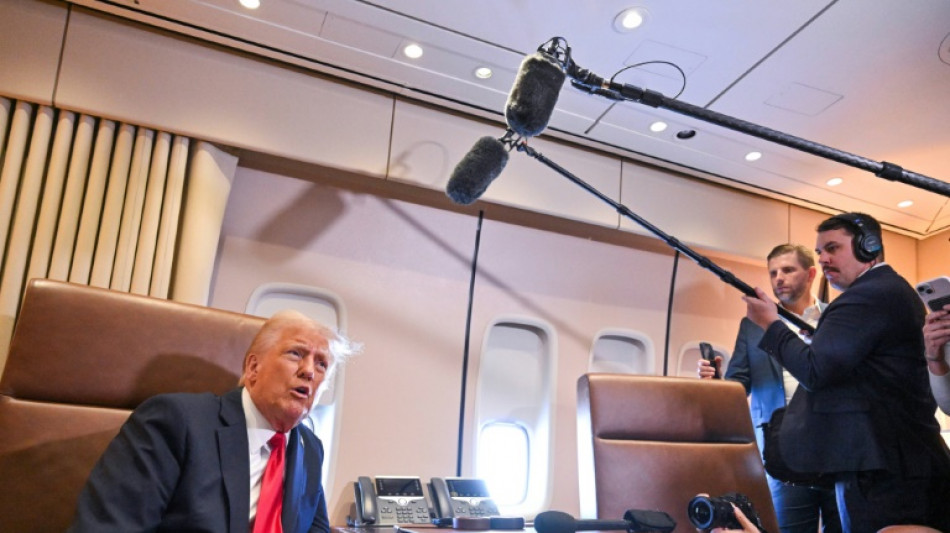
Trump says will impose 25% tariffs on US steel, aluminum imports / Photo: ROBERTO SCHMIDT - AFP

 Kenya's economy faces climate change risks: World Bank

 Campaigning starts in Central African Republic quadruple election

 First urban cable car unveiled outside Paris

 US unseals warrant for tanker seized off Venezuelan coast

 Crypto firm Tether bids for Juventus, is quickly rebuffed

 Can Venezuela survive US targeting its oil tankers?

 World stocks retrench, consolidating Fed-fuelled gains

 World stocks consolidate Fed-fuelled gains

 Stocks rally in wake of Fed rate cut

 British porn star to be deported from Bali after small fine

 Spain opens doors to descendants of Franco-era exiles

 Thai teacher finds 'peace amidst chaos' painting bunker murals

 South Korea exam chief quits over complaints of too-hard tests

 South Korea exam chief resigns after tests dubbed too hard

 Laughing about science more important than ever: Ig Nobel founder

 Crypto mogul Do Kwon sentenced to 15 years for fraud: US media

 Make your own Mickey Mouse clip - Disney embraces AI

 Dark, wet, choppy: Machado's secret sea escape from Venezuela

 2024 Eurovision winner Nemo returns trophy over Israel's participation

 Make your own AI Mickey Mouse - Disney embraces new tech

 Floodworks on Athens 'oasis' a tough sell among locals

 German growth forecasts slashed, Merz under pressure

 ECB proposes simplifying rules for banks

 Desert dunes beckon for Afghanistan's 4x4 fans

 Chocolate prices high before Christmas despite cocoa fall

The United States will move to impose 25-percent tariffs on steel and aluminum imports this week, President Donald Trump said Sunday, the latest in a slew of trade levies he has announced.
Trump told reporters aboard Air Force One that the tariffs, which he will announce on Monday, will apply to "any steel coming into the United States," adding this will also affect aluminum.
Trump imposed similar tariffs during his 2017-2021 presidency to protect US industries, which he believed faced unfair competition from Asian and European countries.
Canada -- which Trump has already threatened with tariffs -- is the largest source of steel and aluminum imports to the United States, according to US trade data. Brazil, Mexico and South Korea are also major steel providers to the country.
On Sunday, the Republican billionaire also said he would announce "reciprocal tariffs" to match his government's levies to the rates charged by other countries on US products.
"Every country will be reciprocal," Trump said, adding that he would make a detailed announcement on the tariffs on Tuesday or Wednesday.
The president has already shown his fondness for weaponizing the United States' financial power, ordering tariffs on key trade partners China, Mexico and Canada soon after he took office.
He paused 25-percent levies against Canada and Mexico for a month after both countries vowed to step up measures to counter flows of the drug fentanyl and the crossing of undocumented migrants into the United States.
The tariffs against China went ahead, however, with products entering the United States facing additional levies of 10 percent since Tuesday.
Beijing responded with targeted tariffs on certain US products such as coal and liquefied natural gas, which will come into play on Monday.
The new Chinese tariffs cover $14 billion worth of US goods, while the tariffs announced by Trump cover $525 billion worth of Chinese goods, according to Goldman Sachs.
- 'Golden age' -
Trump has also pledged tariffs on the European Union and said that he would soon announce unspecified "reciprocal tariffs."
French President Emmanuel Macron vowed in an interview aired Sunday to go head-to-head with Trump over his financial threats to Europe, though he said that the United States should focus its efforts on China rather than the European Union.
Macron also warned on CNN that Americans would feel the effects of any tariffs on Europe, saying they "will increase the costs and create inflation in the US."
And in an otherwise friendly meeting Friday with Japanese Prime Minister Shigeru Ishiba, Trump warned Tokyo could still face tariffs on exported goods if it fails to cut the US trade deficit with Japan to zero.
The trade deficit of the United States -- the world's largest economy -- widened last year to nearly $920 billion.
Trump, who has promised a "new golden age" for the United States, has insisted that the impact of any tariffs would be borne by foreign exporters without being passed on to US consumers, despite most experts saying the contrary.
But he did acknowledge after announcing tariffs on Mexico, Canada and China earlier this month that Americans might feel economic "pain."
Trump has wielded tariffs as a threat to achieve his wider policy goals, most recently when he said he would slap them on Colombia when it turned back US military planes carrying deported migrants.
After a day-long showdown with Trump, the Colombian government backed down.
Y.Ponomarenko--CPN