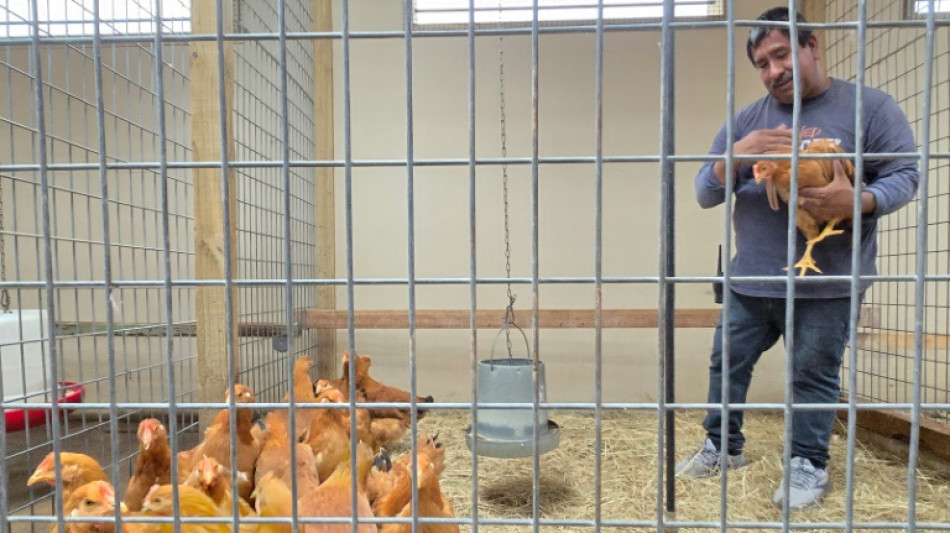
Facing egg shortage, Americans bring chickens home to roost / Photo: Moisés ÁVILA - AFP

 Kenya's economy faces climate change risks: World Bank

 Crypto firm Tether bids for Juventus, is quickly rebuffed

 Can Venezuela survive US targeting its oil tankers?

 World stocks retrench, consolidating Fed-fuelled gains

 World stocks consolidate Fed-fuelled gains

 Stocks rally in wake of Fed rate cut

 British porn star to be deported from Bali after small fine

 Spain opens doors to descendants of Franco-era exiles

 Thai teacher finds 'peace amidst chaos' painting bunker murals

 South Korea exam chief quits over complaints of too-hard tests

 South Korea exam chief resigns after tests dubbed too hard

 Laughing about science more important than ever: Ig Nobel founder

 Crypto mogul Do Kwon sentenced to 15 years for fraud: US media

 Make your own Mickey Mouse clip - Disney embraces AI

 Dark, wet, choppy: Machado's secret sea escape from Venezuela

 2024 Eurovision winner Nemo returns trophy over Israel's participation

 Make your own AI Mickey Mouse - Disney embraces new tech

 Floodworks on Athens 'oasis' a tough sell among locals

 German growth forecasts slashed, Merz under pressure

 ECB proposes simplifying rules for banks

 Desert dunes beckon for Afghanistan's 4x4 fans

 Chocolate prices high before Christmas despite cocoa fall

 Asian traders cheer US rate cut but gains tempered by outlook

 Oracle shares dive as revenue misses forecasts

 Divided US Fed makes third straight rate cut, signals higher bar ahead

A Houston poultry supply company is selling chickens like there is no tomorrow, as sky-high prices for eggs prompt some Americans to produce their own at home.
A recent US outbreak of bird flu since early 2024 is exacting a heavy toll on poultry farms. More than 21 million egg-laying hens have been "depopulated" this year so far, after 13.2 million were culled in December, according to the US Department of Agriculture.
Eggs, as a result, are a precious commodity these days.
John Berry, who manages a livestock company in Houston, reported a dramatic increase in demand for chickens as consumers grapple with the egg shortage.
"Our sales for poultry have doubled or maybe potentially tripled. I mean we're selling 100 chickens a week or more," Berry told AFP.
In times of egg abundance it would take two or three weeks to sell that many birds, he said.
A dozen premium eggs can now cost an eye-popping $10 in some US supermarkets, with even lower-grade ones now drawing twice their usual price of what is normally between two and three dollars.
The popular grocery store chain Trader Joe's is limiting purchases to one dozen eggs of any kind per household per day, and Costco is also limiting purchases.
Waffle House restaurants have slapped a 50-cent surcharge on each egg in a dish to compensate for higher costs.
Last week in Seattle, a restaurant was robbed of 500 eggs from its storeroom in the middle of the night.
- ' I have a large family' -
Berry said most of his chicken buyers are new to the world of egg production.
Such is the case of Arturo Becerra, who recently bought 10 hens for $400, with another $20 for a month's worth of feed.
On Monday, he bought five more hens, and plans to get another 10, "because I have a large family." His hens are still young and need a few more weeks to start laying eggs.
Some cities and towns in Texas allow people to raise chickens at home if they follow certain health norms.
The US Centers for Disease Control and Prevention (CDC) say the risk to the general public from avian flu remains "low," but has released safety guidelines for owners of backyard bird flocks.
The CDC also says that "people with job-related or recreational exposures to birds or other H5 virus-infected animals, are at greater risk of infection."
That has not appeared to deter Becerra.
"Now I have some place to put them, and besides, eggs are very expensive," said Becerra, a 57-year-old man who was born in Mexico. "I think it will be cheaper to buy hens and raise them."
Billy Underhill, the 62-year-old owner of a construction company and longtime chicken raiser, has bought two more of the clucking creatures.
"I just heard someone yesterday say that eggs were, like, 10 dollars a dozen," he said.
"I was already planning on buying a couple more chickens. I buy a couple every couple months because some of them die. Eventually they die and they stop laying so I'm going to keep the flow of eggs going in my family," he said.
Berry said there are no chickens to replace the millions that had to be killed because of avian influenza.
"You have to have had anticipated this and raised a thousand extra chickens or a million extra chickens," said Berry.
In the United States, the disease is affecting not just poultry farms but also dairy cows.
There have been 68 cases among people since early last year, with one of them fatal. Most of them were among people coming into contact with infected animals, according to the CDC.
The man who died was infected "after exposure to a combination of a non-commercial backyard flock and wild birds," health authorities said.
Berry said there is a generation of chickens growing and waiting to replace the ones who were destroyed. But it will take time, and as eggs store well, he recommends that people stock up.
"It'll be a couple of months, I would guess at the soonest. Seems like it's two or three months or more before things kind of get right."
A.Samuel--CPN