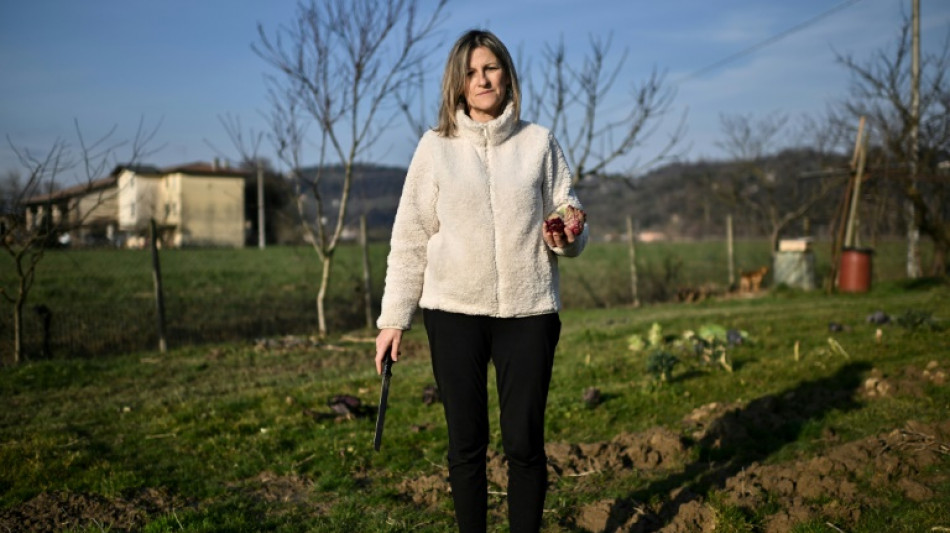
The Italian mums who 'poisoned' their children / Photo: Marco BERTORELLO - AFP

 Kenya's economy faces climate change risks: World Bank

 Crypto firm Tether bids for Juventus, is quickly rebuffed

 Can Venezuela survive US targeting its oil tankers?

 World stocks retrench, consolidating Fed-fuelled gains

 World stocks consolidate Fed-fuelled gains

 Stocks rally in wake of Fed rate cut

 British porn star to be deported from Bali after small fine

 Spain opens doors to descendants of Franco-era exiles

 Thai teacher finds 'peace amidst chaos' painting bunker murals

 South Korea exam chief quits over complaints of too-hard tests

 South Korea exam chief resigns after tests dubbed too hard

 Laughing about science more important than ever: Ig Nobel founder

 Crypto mogul Do Kwon sentenced to 15 years for fraud: US media

 Make your own Mickey Mouse clip - Disney embraces AI

 Dark, wet, choppy: Machado's secret sea escape from Venezuela

 2024 Eurovision winner Nemo returns trophy over Israel's participation

 Make your own AI Mickey Mouse - Disney embraces new tech

 Floodworks on Athens 'oasis' a tough sell among locals

 German growth forecasts slashed, Merz under pressure

 ECB proposes simplifying rules for banks

 Desert dunes beckon for Afghanistan's 4x4 fans

 Chocolate prices high before Christmas despite cocoa fall

 Asian traders cheer US rate cut but gains tempered by outlook

 Oracle shares dive as revenue misses forecasts

 Divided US Fed makes third straight rate cut, signals higher bar ahead

Elisabetta Donadello "poisoned" her children. After unwittingly living off polluted land in northeast Italy for decades, she had toxic chemicals in her blood -- which she passed on with each pregnancy.
Donadello, 50, is one of thousands of mothers in the region who discovered they had ingested "forever chemicals" known as PFAS and transmitted them to their babies, both in the womb and through breastfeeding.
Some are now civil plaintiffs in a criminal case against chemicals company Miteni, which is accused of causing one of Europe's biggest environmental disasters for discharging the hormone-altering substances into water sources, affecting 350,000 people.
"For 40 years I ate the vegetables grown here, and passed them on to my children in pregnancy... so basically I poisoned my children," said Donadello, who lives in the house in which she grew up.
Both children, now eight and 10, have high levels in their blood, but especially Donadello's first born, "because it's awful... the mother dumps them (the chemicals) on her first child", she told AFP.
Chronic exposure to even low levels of PFAS has been linked to liver damage, high cholesterol, reduced immune responses, low birthweights and several kinds of cancer.
Donadello says both children appear well, but she finds herself watching them closely for sickness.
"I'm afraid. I don't have normal reactions when they have even trivial symptoms... because there is always the fear that it could mean something is happening because of the pollutants," she said.
- No taste, colour, smell -
Fifteen managers of the Miteni factory are on trial in Vicenza, accused of knowingly leaking PFAS into a waterway that fed into others, polluting a vast area between Vicenza, Verona and Padova.
Donadello is part of a group of mothers dubbed the "Mamme No PFAS" (Mums Against PFAS), who united after discovering their families had the chemicals in their blood.
She lives around 12 kilometres (7.5 miles) from the factory, which is now closed down. But her garden sits above a polluted aquifer that feeds the well and was used to water the allotment.
She stopped using the well in 2015 and has turned it and part of her allotment over to scientists from Padua University, so they can study the extent to which the water with PFAS contaminates fruit and vegetables.
"The first year salad and tomatoes were planted. Soil and water analysis before, during and after, showed the vegetables... if irrigated with contaminated water, are themselves contaminated," she said.
The vegetables now watered with rainwater are safe, but the family has stopped eating their home-grown kiwis or making grape jam from their vines, for the plants have deep roots that draw on the aquifer.
Donadello said PFAS were found even in the eggs from the family's free-range chickens.
She and other campaigners accuse Veneto regional authorities of failing to properly inform people about the contamination, so that many families continue blithely to eat home-grown or locally grown produce.
The region is also a plaintiff in the case.
"PFAS have no taste, colour or smell, (so) the vegetables taste fantastic," she said.
"How do you convince someone who has been eating the things he has been self-producing for his whole life... to stop eating them? With indisputable data, stated clearly and with authority."
- Paradise lost -
Donadello's 84-year-old father has a tractor, a shed piled high with tools and a passion for the allotment. She remembers helping him as a child, pulling up radishes and leeks with her sister.
He was reluctant to stop using the land, and only did so when faced with his grandchildren's blood test results.
"It's terrible for a person who is in touch with his land to think that he can no longer use it," Donadello said as she watched him and her young son uproot a contaminated cherry tree.
The Miteni factory shut in 2018 but the land is still full of PFAS, which are washed into the torrent running beside it when it rains.
Donadello is close to tears when she looks across the green fields to snow-capped mountains beyond and thinks of the ruin of what was once "my paradise".
"It is painful to think that poisoned water is flowing under my feet, and it will probably be like that forever, if there is no cleanup," she said.
"This was my grandparents' land, my father's land. What am I leaving to my children?"
D.Goldberg--CPN