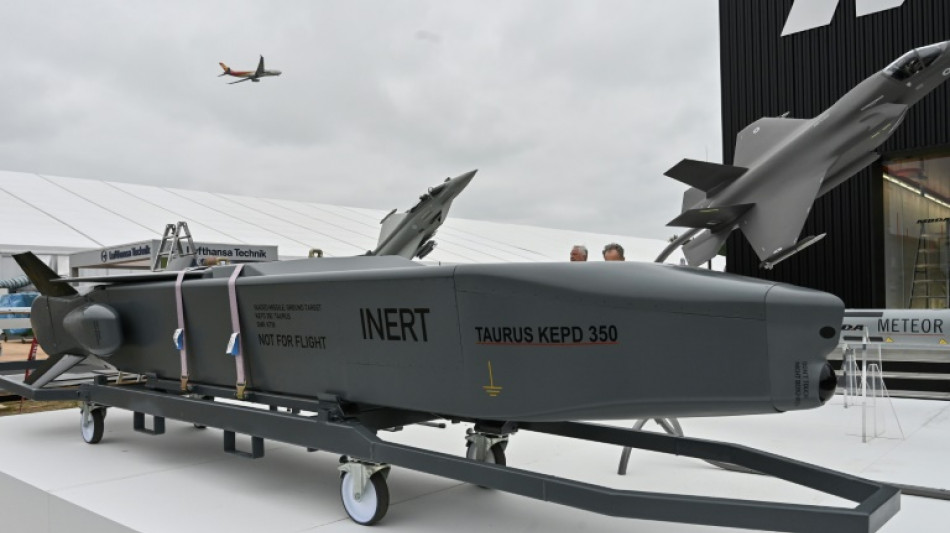
German parliament to vote on huge spending boost for defence, infrastructure / Photo: RALF HIRSCHBERGER - AFP/File

 Kenya's economy faces climate change risks: World Bank

 Crypto firm Tether bids for Juventus, is quickly rebuffed

 Can Venezuela survive US targeting its oil tankers?

 World stocks retrench, consolidating Fed-fuelled gains

 World stocks consolidate Fed-fuelled gains

 Stocks rally in wake of Fed rate cut

 British porn star to be deported from Bali after small fine

 Spain opens doors to descendants of Franco-era exiles

 Thai teacher finds 'peace amidst chaos' painting bunker murals

 South Korea exam chief quits over complaints of too-hard tests

 South Korea exam chief resigns after tests dubbed too hard

 Laughing about science more important than ever: Ig Nobel founder

 Crypto mogul Do Kwon sentenced to 15 years for fraud: US media

 Make your own Mickey Mouse clip - Disney embraces AI

 Dark, wet, choppy: Machado's secret sea escape from Venezuela

 2024 Eurovision winner Nemo returns trophy over Israel's participation

 Make your own AI Mickey Mouse - Disney embraces new tech

 Floodworks on Athens 'oasis' a tough sell among locals

 German growth forecasts slashed, Merz under pressure

 ECB proposes simplifying rules for banks

 Desert dunes beckon for Afghanistan's 4x4 fans

 Chocolate prices high before Christmas despite cocoa fall

 Asian traders cheer US rate cut but gains tempered by outlook

 Oracle shares dive as revenue misses forecasts

 Divided US Fed makes third straight rate cut, signals higher bar ahead

German lawmakers will vote Tuesday on a massive spending boost for defence and infrastructure proposed by chancellor-in-waiting Friedrich Merz amid concern over the United States' commitment to Europe's security.
The hastily drawn plans represent a radical departure for a country traditionally reluctant to take on large amounts of debt or to spend heavily on the military, given the horrors of its Nazi past.
But Merz, 69, whose conservative CDU/CSU alliance won an election last month, has urged swift action as concerns grow that the United States' decades-old commitment to European defence is faltering under President Donald Trump.
In an interview with public broadcaster ARD on Sunday, Merz said the "situation has worsened in recent weeks", citing Trump's overtures to Russia to end the Ukraine war and his wavering commitment to NATO.
"That is why we have to act fast," Merz said.
Merz's plans envisage exempting defence spending from the country's strict debt rules when it exceeds one percent of GDP and setting up a 500-billion-euro ($545-billion) fund for infrastructure investments.
As well as boosting domestic investments, the spending package -- dubbed a fiscal "bazooka" by German media -- would free up an extra three billion euros ($3.3 billion) of support for Ukraine in 2025.
Outgoing Foreign Minister Annalena Baerbock said the plans were a "strong signal that Germany is serious about its own security, about the security of Ukraine and about the security of Europe".
The massive funding boost represents "a fiscal sea change for Germany," wrote Holger Schmieding of Berenberg Bank.
He added that Merz and his team "are rising to the challenges which Germany is facing in times of almost unprecedented geopolitical upheaval for Europe".
- Political limbo -
Germany is currently in political limbo, with Merz embroiled in negotiations to form a coalition with the Social Democrats (SPD) of outgoing Chancellor Olaf Scholz.
The conservatives and the SPD agreed the plans to boost the country's under-resourced military and ailing economy as part of their initial coalition talks in early March.
But instead of waiting until the new government is formed, the parties want to get the spending plans approved by the outgoing parliament, which remains in place until next week.
In the next chamber, the far-right Alternative for Germany (AfD) and the far-left Die Linke -- which both oppose the plans -- would have the numbers needed to block them.
Even in the outgoing parliament, the CDU/CSU and SPD are relying on the support of the Greens to help them reach the two-thirds majority required to modify the debt brake.
The Greens had threatened to withhold their support, but a deal was struck late last week with Merz agreeing that 100 billion euros of the infrastructure fund will be dedicated to climate-protection measures.
Merz on Monday said he was "confident" the plans would be voted through on Tuesday.
The deal hangs on a margin of 31 votes, according to Der Spiegel magazine, which warned that "some departing parliamentarians could take the opportunity to get back at the new government with a no vote".
Ursula Muench, director of the Academy for Political Education, said there was still "significant uncertainty" around the vote.
A failure to achieve the required majority would be a "debacle for the coalition in the process of being formed... and ultimately for Friedrich Merz," she said.
The measures must also still be voted through the Bundesrat, the upper house of parliament, on Friday, where they also require a two-thirds majority.
Coalition negotiations often last several weeks, or even months, in Germany. But Merz has set out an ambitious schedule to have a government in place by Easter or soon after.
If all goes according to plan, the new parliament will vote on whether to appoint him as chancellor on April 23.
X.Cheung--CPN