
Too much water: Gold rush, climate change submerge Bolivian village / Photo: AIZAR RALDES - AFP

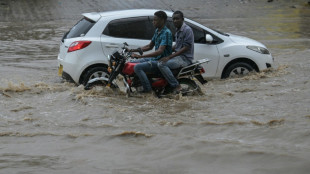 Kenya's economy faces climate change risks: World Bank

 'Stop the slaughter': French farmers block roads over cow disease cull

 Why SpaceX IPO plan is generating so much buzz

 World stocks mostly slide, consolidating Fed-fuelled gains

 UK's king shares 'good news' that cancer treatment will be reduced in 2026

 Salah admired from afar in his Egypt home village as club tensions swirl

 Iran frees child bride sentenced to death over husband's killing: activists

 France updates net-zero plan, with fossil fuel phaseout

 EU agrees recycled plastic targets for cars

 British porn star fined, faces imminent Bali deportation

 Indonesia floods were 'extinction level' for rare orangutans

 Japan bear victim's watch shows last movements

 French indie 'Clair Obscur' dominates Game Awards

 Asian markets track Wall St record after Fed cut

 Vaccines do not cause autism: WHO

 'In her prime': Rare blooming of palm trees in Rio

 OpenAI beefs up GPT models in AI race with Google

 Cyclone causes blackout, flight chaos in Brazil's Sao Paulo

 US bringing seized tanker to port, as Venezuela war threats build

 Time magazine names 'Architects of AI' as Person of the Year

 OpenAI, Disney to let fans create AI videos in landmark deal

 Thyssenkrupp pauses steel production at two sites citing Asian pressure

 Stocks mixed as US rate cut offset by Fed outlook, Oracle earnings

 Breakout star: teenage B-girl on mission to show China is cool

 Austria set to vote on headscarf ban in schools

Navigating a makeshift raft between drifting furniture and submerged cars, Rafael Quispe steers through his village in western Bolivia, where the streets were turned into rivers two months ago.
His home is one of about 500 partly immersed in floodwaters in the village of Tipuani in the heart of a gold-mining region.
Gold mining has carved away at the banks of the river that runs through the municipality of 7,500 inhabitants. That, combined with unusual rains attributed to climate change, is to blame for the flooding, experts say.
Quispe, 54, is himself a miner and also used to run a bar out of his home.
"This town, as beautiful as it once was, is now a disaster," he told AFP.
The region is no stranger to flooding, and some of Tipuani's streets have been bogged down in a green sludge for more than a year -- a mixture of river water, rain, and overflow from a collapsed drainage system.
For the last three years, the region has been flooded every rainy season, which runs from November to April.
The municipality says 92 percent of residents make a living from mining and related activities around the isolated village -- accessible from the nearest main road only by a 30-kilometer (18.6-mile) trail of mud and rock dotted with tumultuous streams.
But the industry on which the village depends is also blamed for its demise.
A gold rush, with prices more than tripling in the past decade, has seen an increase in mechanical extraction of the noble metal in Bolivia.
With their machines, mining cooperatives are removing "land that should not be removed" and dumping their waste in the river -- altering its course and "causing floods," said Alfredo Zaconeta, a researcher at the Center for Labor and Agricultural Development Studies (Cedla).
- 'A sin' -
In Tipuani, former miner Sinforiano Checa, 67, has been living in a tent since his house was flooded in January.
What the mining companies do "is a sin," he told AFP, breathing laboriously due to silicosis -- a lung disease he contracted after many years of inhaling silica dust while digging for gold.
"This is nothing new, it's been going on for many years. All the waste was dumped into the river," said Rolando Vargas, president of the Chima Cooperative -- one of 14 extracting gold from the bed of the Tipuani river.
The practice stopped two years ago, Vargas told AFP, adding he felt "somewhat" responsible for the ills that have befallen the community.
After his interview with AFP, Vargas was reported missing, his truck swept away by the raging river, according to his family's social media posts.
- 'Totally anomalous' -
In the village of Chima, about 20 minutes from Tipuani in a 4x4 vehicle, children splash and ride bicycles in the contaminated waters surrounding their homes and school, which has been closed since February.
Those who have access to the internet, often patchy, follow classes online.
"The town may disappear but we have to keep working. What are we going to live on if we don't work?" said Manuel Barahona, a gray-haired 63-year-old whose house is also under water.
Added to the river-altering effects of gold mining, are the ravages of climate change in one of the poorest countries in Latin America.
Bolivia is one of the ten most exposed countries in the world to climate change, according to the 2021 Global Climate Risk Index compiled by advocacy group Germanwatch.
And the Alliance for Global Water Adaptation, an NGO that advises on policy, said in a report last year that "climate change is intensifying Bolivia's water vulnerabilities... increasing the frequency and severity of droughts and floods."
The rains that fell on Tipuani were the most intense for a month of January since 2012, according to Bolivia's National Meteorology and Hydrology Service (Senamhi).
"It is totally anomalous" for a period marked by the La Nina weather phenomenon that ordinarily brings less rainfall, not more, said Lucia Walper, head of forecasting at Senamhi.
Last year's record forest fires in Bolivia's east have also altered rainfall patterns, with less vegetation to retain moisture over the Amazon meaning more rains fall further west on the high plains, she explained.
C.Smith--CPN