
Countries must 'make the best' of new multipolar world: IMF chief / Photo: Jim WATSON - AFP

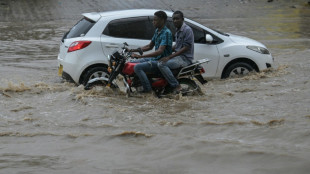 Kenya's economy faces climate change risks: World Bank

 Crypto firm Tether bids for Juventus, is quickly rebuffed

 Can Venezuela survive US targeting its oil tankers?

 World stocks retrench, consolidating Fed-fuelled gains

 World stocks consolidate Fed-fuelled gains

 Stocks rally in wake of Fed rate cut

 British porn star to be deported from Bali after small fine

 Spain opens doors to descendants of Franco-era exiles

 Thai teacher finds 'peace amidst chaos' painting bunker murals

 South Korea exam chief quits over complaints of too-hard tests

 South Korea exam chief resigns after tests dubbed too hard

 Laughing about science more important than ever: Ig Nobel founder

 Crypto mogul Do Kwon sentenced to 15 years for fraud: US media

 Make your own Mickey Mouse clip - Disney embraces AI

 Dark, wet, choppy: Machado's secret sea escape from Venezuela

 2024 Eurovision winner Nemo returns trophy over Israel's participation

 Make your own AI Mickey Mouse - Disney embraces new tech

 Floodworks on Athens 'oasis' a tough sell among locals

 German growth forecasts slashed, Merz under pressure

 ECB proposes simplifying rules for banks

 Desert dunes beckon for Afghanistan's 4x4 fans

 Chocolate prices high before Christmas despite cocoa fall

 Asian traders cheer US rate cut but gains tempered by outlook

 Oracle shares dive as revenue misses forecasts

 Divided US Fed makes third straight rate cut, signals higher bar ahead

Countries have no choice but to "make the best" of the fragmentation of the global economy by boosting ties with regional and like-minded countries, the head of the International Monetary Fund said in an interview Thursday.
"Yes, (it's) much better for the world to get one system of rules, much better, and hopefully we will retain the basic principles of this common system for the future," IMF Managing Director Kristalina Georgieva told AFP.
"But we are in a multipolar world," she said. "And my call is, rather than wishing this away, wishing that the world turns back to where it was, we work hard to make the best out of economic relations."
Georgieva spoke to AFP ahead of next week's Spring Meetings, a gathering of global financial leaders co-hosted by the World Bank and the IMF in Washington.
Earlier Thursday, Georgieva said the IMF expects the global economy to cool after the introduction of US President Donald Trump's tariff plans, which have roiled financial markets and caused economists to slash forecasts for growth and hike them for inflation.
However, the IMF still expects the world will avoid a recession.
"What we have observed over the last years is that more and more countries seek ways to improve their trade relations with selected partners," Georgieva told AFP.
"And in this environment, it is likely to continue, maybe even accelerate, so we will see more bilateral and plurilateral agreements," she said, pointing to places like southeast and central Asia, and Gulf Cooperation Council (GCC) countries.
- 'Very significant manner'
Since returning to the White House in January, Trump has embarked on an aggressive, stop-start rollout of tariffs in an attempt to rapidly rebalance trading relationships.
Most US trading partners currently face a 10 percent "baseline" rate, while China -- the world's second-largest economy -- faces new tariffs totaling 145 percent.
"What we see in the United States is a decision to act on something that has been a concern also for the previous administration," Georgieva told AFP.
"The concentration on unfair trade practices, on the necessity to level the playing field, on security concerns is not really new," she said.
"What is new is that determination to act in a very significant manner, and that created a surprise domestically and internationally," she added.
Georgieva said it was important to note that the negotiations were still ongoing, and cautioned against assuming that tariffs would end up being higher at the end of the process.
"Some of the trading partners of (the) US have indeed been holding on higher tariff and non-tariff barriers," she said.
"Should they bring them down and do so across the board that may have a positive impact overall on where we land."
As well as imposing tariffs, Trump's administration has also slashed foreign aid funding, with many other top international donors including France and Britain doing the same.
"They are many low-income countries where, for a variety of reasons, generating domestic resources is very limited," she said, pointing to weak tax systems and large, informal economies.
"This is the moment to please get your own house in order," she added.
But, she said, the IMF is also working "very hard" to see if wealthier emerging market economies like those in the GCC can step up and do more bilaterally.
"Every penny matters," she said. "And when it is in the context of (an) international response, then the use of money is more efficient."
"It's better for the country, better for the donors," she added.
A.Leibowitz--CPN