
Countries could use forests to 'mask' needed emission cuts: report / Photo: Sergio Lima - AFP/File

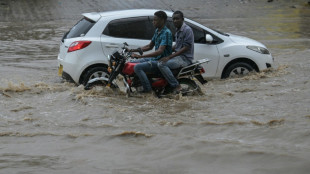 Kenya's economy faces climate change risks: World Bank

 'Stop the slaughter': French farmers block roads over cow disease cull

 Why SpaceX IPO plan is generating so much buzz

 World stocks mostly slide, consolidating Fed-fuelled gains

 UK's king shares 'good news' that cancer treatment will be reduced in 2026

 Salah admired from afar in his Egypt home village as club tensions swirl

 Iran frees child bride sentenced to death over husband's killing: activists

 France updates net-zero plan, with fossil fuel phaseout

 EU agrees recycled plastic targets for cars

 British porn star fined, faces imminent Bali deportation

 Indonesia floods were 'extinction level' for rare orangutans

 Japan bear victim's watch shows last movements

 French indie 'Clair Obscur' dominates Game Awards

 Asian markets track Wall St record after Fed cut

 Vaccines do not cause autism: WHO

 'In her prime': Rare blooming of palm trees in Rio

 OpenAI beefs up GPT models in AI race with Google

 Cyclone causes blackout, flight chaos in Brazil's Sao Paulo

 US bringing seized tanker to port, as Venezuela war threats build

 Time magazine names 'Architects of AI' as Person of the Year

 OpenAI, Disney to let fans create AI videos in landmark deal

 Thyssenkrupp pauses steel production at two sites citing Asian pressure

 Stocks mixed as US rate cut offset by Fed outlook, Oracle earnings

 Breakout star: teenage B-girl on mission to show China is cool

 Austria set to vote on headscarf ban in schools

Major economies are overstating how much carbon their forests can absorb in a climate accounting fudge that could allow them to use even more fossil fuels, new research said Thursday.
The assessment singled out Brazil and Australia, and warned a lack of rules around accounting for forests and other land-based carbon sinks meant countries could "game the system" when reporting their national greenhouse gas emissions.
Scientists are still unclear about how carbon sinks might behave as the planet warms in future, and exactly how much heat-trapping carbon dioxide they might soak up from the atmosphere.
But that has not stopped countries from making their own assumptions and using those numbers in their national climate plans, which are due to be finalised to 2035 before the next UN climate talks in Brazil in November.
Climate Analytics, a policy institute that independently assesses these plans, said overly optimistic assumptions about how much CO2 forests might draw down was "masking the scale and pace of the fossil fuel emissions cuts needed".
This concealed the true effort needed to limit global warming to 1.5 degrees Celsius above pre-industrial levels, the ambition set out in the 2015 Paris climate agreement.
In the latest versions of its climate plan, Australia had leaned so heavily on forests to reduce its carbon footprint that it would amount to scaling back real cuts to emissions by 10 percent, Climate Analytics said.
Brazil, meanwhile, has announced its own pledge to cut emissions by 59 to 67 percent below 2005 levels by 2035, but has not defined the extent to which forests will help meet this goal.
Climate Analytics said structuring the target in this manner meant Brazil could still allow its energy emissions to double.
"If you don't use forests, then everything has to be done by the energy sector," said Claudio Forner, who co-authored the new research by Climate Analytics.
"But if you use all forests, then the emissions actually can continue growing."
He said the problem had arisen because the Paris climate deal allowed for countries to come up with their own assumptions about how much CO2 would be absorbed by their land.
"Without rules, countries just game the system," Forner told AFP.
- Assuming growth -
While forests will be crucial to global efforts to reduce planet-heating emissions, these estimates should be listed separately and not used to "offset" energy and industry emissions, he said.
That is because the complex processes by which forests and other land sinks absorb carbon are not as well understood as the role of fossil fuels in driving climate change.
Carbon stored in trees can also be released back into the atmosphere in the event of forest fires and other natural mechanisms.
There are also concerns that climate change and other human-driven factors are weakening the ability of forests and soils to soak up carbon.
"Science doesn't understand how the carbon sink is going to be behaving into the future," said Forner.
"And if scientists don't, I'm sure that most governments don't either, but they still just use assumptions of continuing growth to their numbers. If those assumptions are wrong, then you have this deficit."
Climate Analytics has previously estimated this uncertainty could amount to up to three billion tonnes of carbon dioxide -- roughly equivalent to Europe's emissions for a year.
UN climate experts have also raised broad concerns about a "significant discrepancy" between the way countries account for land in their climate plans and the methods used by scientists, which they said could be equal to around 15 percent of global emissions.
In a report last year, they said efforts to realign different accounting systems for land use CO2 emissions and removal would mean the world has less time than previously thought to reach net-zero emissions.
A.Agostinelli--CPN