
Developing countries should fast-track US trade deals: World Bank president / Photo: Brendan SMIALOWSKI - AFP

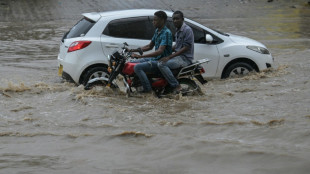 Kenya's economy faces climate change risks: World Bank

 Crypto firm Tether bids for Juventus, is quickly rebuffed

 Can Venezuela survive US targeting its oil tankers?

 World stocks retrench, consolidating Fed-fuelled gains

 World stocks consolidate Fed-fuelled gains

 Stocks rally in wake of Fed rate cut

 British porn star to be deported from Bali after small fine

 Spain opens doors to descendants of Franco-era exiles

 Thai teacher finds 'peace amidst chaos' painting bunker murals

 South Korea exam chief quits over complaints of too-hard tests

 South Korea exam chief resigns after tests dubbed too hard

 Laughing about science more important than ever: Ig Nobel founder

 Crypto mogul Do Kwon sentenced to 15 years for fraud: US media

 Make your own Mickey Mouse clip - Disney embraces AI

 Dark, wet, choppy: Machado's secret sea escape from Venezuela

 2024 Eurovision winner Nemo returns trophy over Israel's participation

 Make your own AI Mickey Mouse - Disney embraces new tech

 Floodworks on Athens 'oasis' a tough sell among locals

 German growth forecasts slashed, Merz under pressure

 ECB proposes simplifying rules for banks

 Desert dunes beckon for Afghanistan's 4x4 fans

 Chocolate prices high before Christmas despite cocoa fall

 Asian traders cheer US rate cut but gains tempered by outlook

 Oracle shares dive as revenue misses forecasts

 Divided US Fed makes third straight rate cut, signals higher bar ahead

Developing countries should strike swift trade deals with the United States at the "earliest possible" opportunity, the president of the World Bank told AFP Friday, after a busy week with global financial leaders in Washington.
Ajay Banga was interviewed by AFP at the World Bank and International Monetary Fund's Spring Meetings, which have been held this year under a cloud of uncertainty about President Donald Trump's stop-start tariff rollout.
The Bank has been advising developing countries to get a deal done quickly with the United States, and to then focus attention on cutting trade barriers and boosting regional flows of goods, Banga said.
"You need to negotiate trade systems with the US at the earliest possible," he said. "If you delay, it hurts everyone."
Trump's tariffs have roiled financial markets, sent volatility surging and spooked investors and consumers.
Since returning to office in January, the US leader has imposed a "baseline" 10 percent tariff on most countries, with much higher duties on China, and 25 percent sector-specific levies on areas including steel, aluminum, and automobiles not manufactured in the United States.
He also introduced much higher tariffs on dozens of countries -- which have since been temporarily paused -- accusing them of having an unfair trade balance with the United States.
- Bessent 'not wrong' on China -
Banga also addressed the criticism levelled by new US Treasury Secretary Scott Bessent at the Bank earlier this week.
Bessent criticized China's "absurd" developing country status and called on Banga and IMF Managing Director Kristalina Georgieva to "earn the confidence of the administration."
"I don't think he's wrong," Banga said of Bessent's comments on China.
"A country that is the size of China and the capability of China, at some point, should no longer be taking money from IBRD," he said, referring the International Bank for Reconstruction and Development -- an arm of the World Bank that lends largely to middle-income countries.
China, he said, still borrowed around $750 million from the IBRD last year, while paying in billions of dollars to the Fund in repayments and donations.
"My view is, I've brought it down to 750 (million), and I'm trying to figure out a way to deal with China to bring it down further," he said. "I want to get it done. And that's what I'm talking to the Chinese about."
Banga said the Trump administration's broader criticisms of the World Bank were not unusual, citing newly-elected governments over the past year in countries including France, Japan, and Korea.
"I keep telling people this is a perfectly constructive request, to say, tell me and show me that you guys are the kind of people that advance the interests of my taxpayer, of my country," he said.
"I take it in that spirit," he said. "There's nothing wrong with it."
- Energy at 'lowest possible cost' -
Since taking the helm of the Washington-based development lender in 2023, Banga has pushed to streamline its operations and encourage private sector participation, while focusing on job creation and electricity connectivity.
Among the Bank's current priorities is a push with the African Development Bank to connect 300 million people in sub-Saharan Africa to electricity by 2030 -- a process that will require a vast amount of new energy to be brought online.
"You should try and get (energy) in the best, accessible way and the lowest possible cost," Banga said, suggesting that in addition to renewable power, nuclear and gas could help provide a base load -- two energy sources the World Bank is currently hesitant to finance.
The Bank's executive board is set to discuss its energy strategy in June, Banga said, adding that funding for both nuclear and gas would likely be on the agenda.
Banga said the Bank is also pushing to encourage great private sector job creation in developing countries -- beyond simply outsourcing jobs from advanced economies.
"Because then you end up with challenges in (advanced economies), and you can see that people are speaking about them with their votes," he added.
St.Ch.Baker--CPN