Austria Covid-19 'gargle' tests in expansion drive

 Kenya's economy faces climate change risks: World Bank

 Crypto firm Tether bids for Juventus, is quickly rebuffed

 Can Venezuela survive US targeting its oil tankers?

 World stocks retrench, consolidating Fed-fuelled gains

 World stocks consolidate Fed-fuelled gains

 Stocks rally in wake of Fed rate cut

 British porn star to be deported from Bali after small fine

 Spain opens doors to descendants of Franco-era exiles

 Thai teacher finds 'peace amidst chaos' painting bunker murals

 South Korea exam chief quits over complaints of too-hard tests

 South Korea exam chief resigns after tests dubbed too hard

 Laughing about science more important than ever: Ig Nobel founder

 Crypto mogul Do Kwon sentenced to 15 years for fraud: US media

 Make your own Mickey Mouse clip - Disney embraces AI

 Dark, wet, choppy: Machado's secret sea escape from Venezuela

 2024 Eurovision winner Nemo returns trophy over Israel's participation

 Make your own AI Mickey Mouse - Disney embraces new tech

 Floodworks on Athens 'oasis' a tough sell among locals

 German growth forecasts slashed, Merz under pressure

 ECB proposes simplifying rules for banks

 Desert dunes beckon for Afghanistan's 4x4 fans

 Chocolate prices high before Christmas despite cocoa fall

 Asian traders cheer US rate cut but gains tempered by outlook

 Oracle shares dive as revenue misses forecasts

 Divided US Fed makes third straight rate cut, signals higher bar ahead

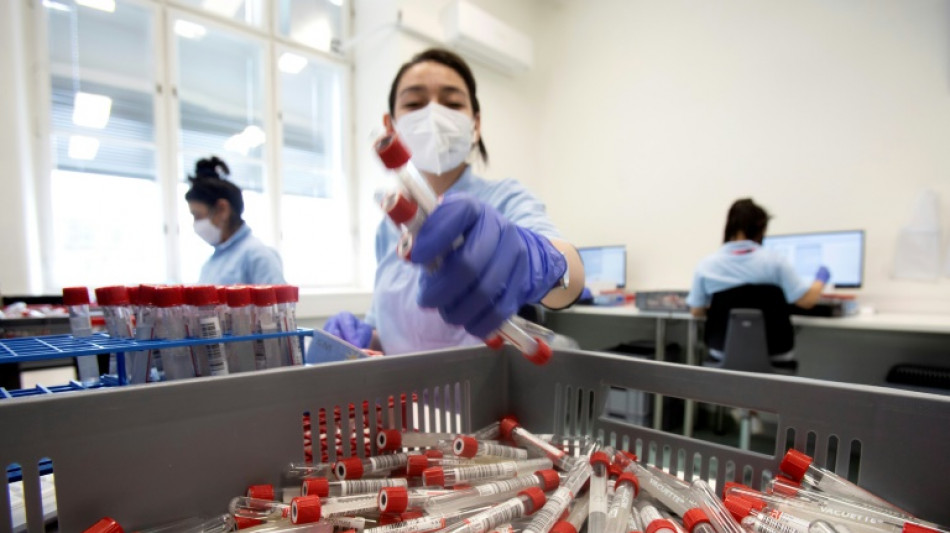
Throughout the day, vans loaded with bags full of Covid PCR test kits arrive at a Vienna laboratory, currently analysing an average of 370,000 tests per day.
With more than 144 million tests carried out since the beginning of the pandemic, the Alpine nation of nine million is a leader in Covid testing.
But with the latest Omicron wave sending cases spiralling, health experts and policymakers are asking if widespread testing -- paid by taxpayers' money -- is necessary and efficient.
The Lifebrain laboratory, which accounts for a major part of the country's testing, has been expanding rapidly since it began work just over a year ago on the sprawling ground of a public hospital on Vienna's outskirts.
Under the "Alles Gurgelt" ("Everybody Gargles") system, Viennese can register online, go to a drugstore, pick up a test kit, gargle at home and then drop the kit back and wait for an email with results within 24 hours.
"It's extremely low-threshold," Lifebrain CEO Michael Havel tells AFP.
- Better screening -
Vienna came up with the system in late 2020 to offer better screening for the capital's two million people.
Havel's laboratory, which analyses the "Everybody Gargles" tests, now employs 1,800 people full time and can analyse up to 800,000 tests a day and run 24/7.
A third of its workforce were hired in the last two months alone. The city pays six euros ($6.80) per test to drugstores and others giving them out.
At the laboratory, workers from dozens of countries drag the bags full of test kits through the aisles of the laboratory set up in rooms in several old buildings on the hospital campus.
Scanning the bar codes on the test tubes one-by-one, they place the tubes into trays for analysis in designated high-tech machines. Computers eventually spit out results saying which batches contain positive Covid samples.
Currently mainly receiving tests from Vienna, Havel says he is prepared to expand capacities within Austria. Before the pandemic Lifebrain, which Havel co-founded, was most active providing laboratory work in Italy.
"Everybody Gargles" tests are already part of the rigorous testing regime in schools -- with students tested several times a week -- and Vienna is now looking to expand the system into kindergartens too.
- 'Gas and break at same time' -
Ulrich Elling, a researcher at the Austrian Academy of Sciences, who helped develop the gargling method, said the "Alles Gurgelt" system was "extremely efficient".
"So far this test strategy has made a lot of sense... (but) now with Omicron, everything is different. If you go for 'herd immunity,' then the question is to what extent it makes sense to step on the gas and brake at the same time," he told AFP.
"In autumn I fear that the next wave will come our way... I think testing will only not be necessary anymore once the pandemic is over," he says.
Y.Jeong--CPN