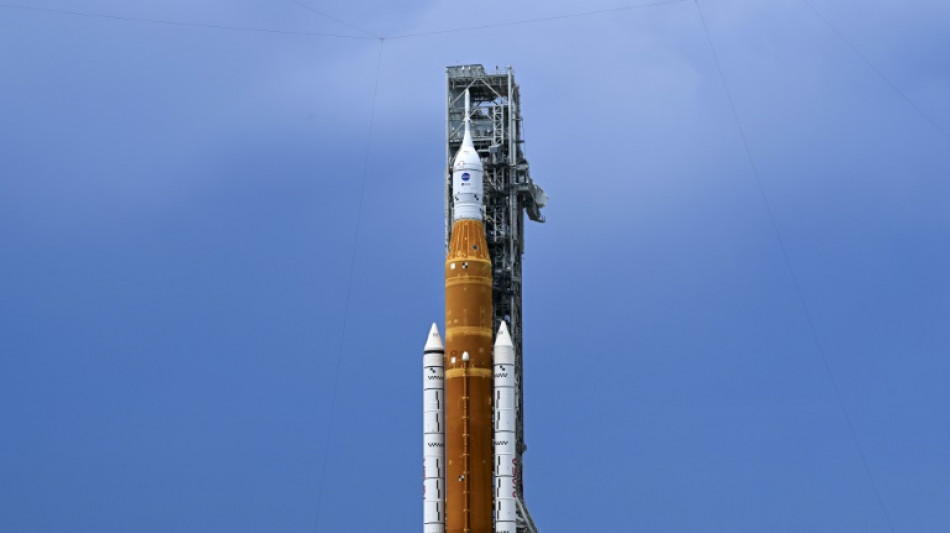
Engine issue forces NASA to scrub launch of giant Moon rocket / Photo: CHANDAN KHANNA - AFP

 Kenya's economy faces climate change risks: World Bank

 'Stop the slaughter': French farmers block roads over cow disease cull

 Why SpaceX IPO plan is generating so much buzz

 World stocks mostly slide, consolidating Fed-fuelled gains

 UK's king shares 'good news' that cancer treatment will be reduced in 2026

 Salah admired from afar in his Egypt home village as club tensions swirl

 Iran frees child bride sentenced to death over husband's killing: activists

 France updates net-zero plan, with fossil fuel phaseout

 EU agrees recycled plastic targets for cars

 British porn star fined, faces imminent Bali deportation

 Indonesia floods were 'extinction level' for rare orangutans

 Japan bear victim's watch shows last movements

 French indie 'Clair Obscur' dominates Game Awards

 Asian markets track Wall St record after Fed cut

 Vaccines do not cause autism: WHO

 'In her prime': Rare blooming of palm trees in Rio

 OpenAI beefs up GPT models in AI race with Google

 Cyclone causes blackout, flight chaos in Brazil's Sao Paulo

 US bringing seized tanker to port, as Venezuela war threats build

 Time magazine names 'Architects of AI' as Person of the Year

 OpenAI, Disney to let fans create AI videos in landmark deal

 Thyssenkrupp pauses steel production at two sites citing Asian pressure

 Stocks mixed as US rate cut offset by Fed outlook, Oracle earnings

 Breakout star: teenage B-girl on mission to show China is cool

 Austria set to vote on headscarf ban in schools

NASA called off a test flight on Monday of its largest-ever rocket in a setback to the ambitious program to send humans back to the Moon and eventually to Mars.
"We don't launch until it's right," NASA administrator Bill Nelson said after an engine temperature issue forced liftoff from Kennedy Space Center to be scrubbed.
"This is a very complicated machine," Nelson said. "You don't want to light the candle until it's ready to go."
Alternative dates for launch of the US space agency's uncrewed Artemis 1 mission are Friday and next Monday.
Blastoff had been planned for 8:33 am (1233 GMT) but was cancelled because of a temperature problem with one of the four RS-25 engines on the 322-foot (98-meter) Space Launch System (SLS) rocket.
NASA said a test to get one of the engines to the proper temperature range for liftoff was not successful.
It said the SLS rocket and Orion crew capsule which sits on top "remain in a safe and stable configuration."
Nelson said delays were "just part of the space business" and expressed confidence that NASA engineers will "get it fixed and then we'll fly."
Tens of thousands of people -- including US Vice President Kamala Harris -- had gathered near the Kennedy Space Center in Florida to watch the launch, which comes 50 years after Apollo 17 astronauts last set foot on the Moon.
The goal of the flight is to test the SLS and Orion crew capsule. Mannequins equipped with sensors are standing in for a crew for the mission.
Overnight operations to fill the orange-and-white rocket with more than three million liters of ultra-cold liquid hydrogen and oxygen were briefly delayed by a high risk of lightning.
Around 3:00 am, another hiccup emerged: a potential leak was detected during the filling of the main stage with hydrogen, causing a pause. After tests, the flow resumed.
NASA engineers later detected the engine temperature problem and put a hold on the countdown before eventually scrubbing the launch.
The rocket's Orion capsule is to orbit the Moon to see if the vessel is safe for people in the near future. At some point, Artemis aims to put a woman and a person of color on the Moon for the first time.
- Extreme temperatures -
During the 42-day trip, the Orion capsule will orbit the Moon, coming within 60 miles (100 kilometers) at its closest approach, and then fire its engines to shoot out 40,000 miles -- a record for a spacecraft rated to carry humans.
One of the mission's primary objectives is to test the capsule's heat shield, which at 16 feet in diameter is the largest ever built.
On its return to Earth's atmosphere, the heat shield will have to withstand speeds of 25,000 miles per hour and a temperature of 5,000 degrees Fahrenheit (2,760 degrees Celsius) -- roughly half as hot as the Sun.
The dummies aboard the spacecraft will record acceleration, vibration and radiation levels.
The craft will also deploy small satellites to study the lunar surface.
A complete failure would be devastating for a program costing $4.1 billion per launch that is already years behind schedule.
- Life on the Moon -
The next mission, Artemis 2, will take astronauts into orbit around the Moon without landing on its surface. The crew of Artemis 3 is to land on the Moon in 2025 at the earliest.
The Artemis program is to establish a lasting human presence on the Moon with an orbiting space station known as Gateway and a base on the surface.
Gateway would serve as a staging and refueling station for a voyage to Mars that would take a minimum of several months.
D.Philippon--CPN