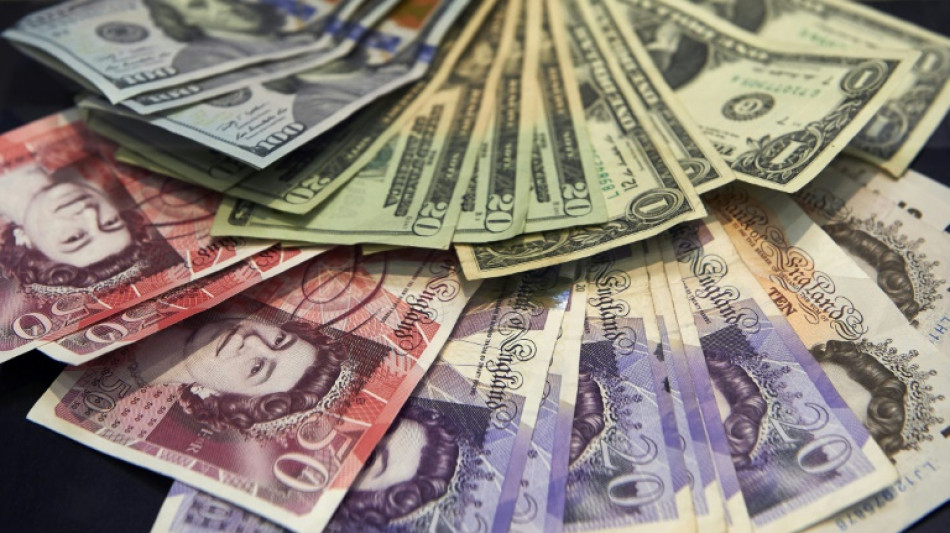
UK political upheaval and stagflation fears weigh on pound / Photo: Niklas HALLE'N - AFP

 Kenya's economy faces climate change risks: World Bank

 'Stop the slaughter': French farmers block roads over cow disease cull

 Why SpaceX IPO plan is generating so much buzz

 World stocks mostly slide, consolidating Fed-fuelled gains

 UK's king shares 'good news' that cancer treatment will be reduced in 2026

 Salah admired from afar in his Egypt home village as club tensions swirl

 Iran frees child bride sentenced to death over husband's killing: activists

 France updates net-zero plan, with fossil fuel phaseout

 EU agrees recycled plastic targets for cars

 British porn star fined, faces imminent Bali deportation

 Indonesia floods were 'extinction level' for rare orangutans

 Japan bear victim's watch shows last movements

 French indie 'Clair Obscur' dominates Game Awards

 Asian markets track Wall St record after Fed cut

 Vaccines do not cause autism: WHO

 'In her prime': Rare blooming of palm trees in Rio

 OpenAI beefs up GPT models in AI race with Google

 Cyclone causes blackout, flight chaos in Brazil's Sao Paulo

 US bringing seized tanker to port, as Venezuela war threats build

 Time magazine names 'Architects of AI' as Person of the Year

 OpenAI, Disney to let fans create AI videos in landmark deal

 Thyssenkrupp pauses steel production at two sites citing Asian pressure

 Stocks mixed as US rate cut offset by Fed outlook, Oracle earnings

 Breakout star: teenage B-girl on mission to show China is cool

 Austria set to vote on headscarf ban in schools

Political uncertainty and growing economic woes, including spiralling inflation and the threat of a recession, are weighing heavily on the British pound, against both the US dollar and the also struggling euro.
The British currency, which is currently trading at around $1.16 for £1, is a barometer of the UK's attractiveness to international investors and has dropped to levels last seen in early 2020 and the shock of the Covid-19 outbreak.
Before that, sterling has not been so cheaply traded since 1985.
Many currencies are struggling against the greenback, which has been galvanised by the US Federal Reserve's stated intention to continue raising its key rates.
European currencies are also suffering from the war in Ukraine and the energy crisis, currently heightened by the threat of a total interruption of Russian gas deliveries.
But the pound is particularly badly hit, losing more than 15 percent against the dollar over the past year.
That has occurred despite the Bank of England (BoE) beginning to raise its key rates at the end of 2021 and repeatedly indicating that it intends to continue this tightening.
Against the euro, which has been weighed down by the European Central Bank's difficulties in tightening its monetary policy, the pound has fallen by two percent this year.
The UK has the highest inflation in the G7, at more 10 percent year-on-year. The BoE estimates that it could rise to 13 percent in October.
Private bank analysts are even more pessimistic: Citi estimates that the peak could reach 18.6 percent in early 2023, while Goldman Sachs suggests 14.8 percent.
- All-time low looming? -
However, inflation could hit 22.4 percent next year if the country's energy prices -- which are set to jump 80 percent in October -- continue their upward spiral as predicted.
That has prompted analysts at Capital Economics to warn sterling could plunge to an all-time low of $1.05, given the toxic cocktail of a likely recession alongside persistently high inflation -- elements of dreaded so-called stagflation.
The term refers to long-running high inflation combined with weak growth and rising unemployment.
Capital Economics argues the BoE will have to stop tightening monetary policy in the coming months, but cannot afford to loosen it either amid that spectre.
Its analysts also note downside risks loom in the form of Liz Truss, the favourite to become prime minister next week, who has threatened to renege on a key element of the country's post-Brexit deal with the European Union.
Former finance minister Rishi Sunak, the other candidate in the race, warned this week it would be "complacent and irresponsible" to ignore the risk of markets losing confidence in Britain, as he attacked Truss's plans to slash taxes.
"The lack of credibility issue Sunak mentions may see the pound continue to weaken" if Truss is confirmed as the ruling Conservatives' next leader on Monday, said Derek Halpenny, a currency analyst at MUFG.
Meanwhile, the broader consequences of leaving the EU and its single market and customs union continue to weigh on the pound, according to economists.
It was trading at less than 80 pence against the euro and more than $1.40 on the eve of the Brexit vote.
Since then, it has lost more than a fifth of its value against the greenback and more than 10 percent against the European single currency.
A.Leibowitz--CPN