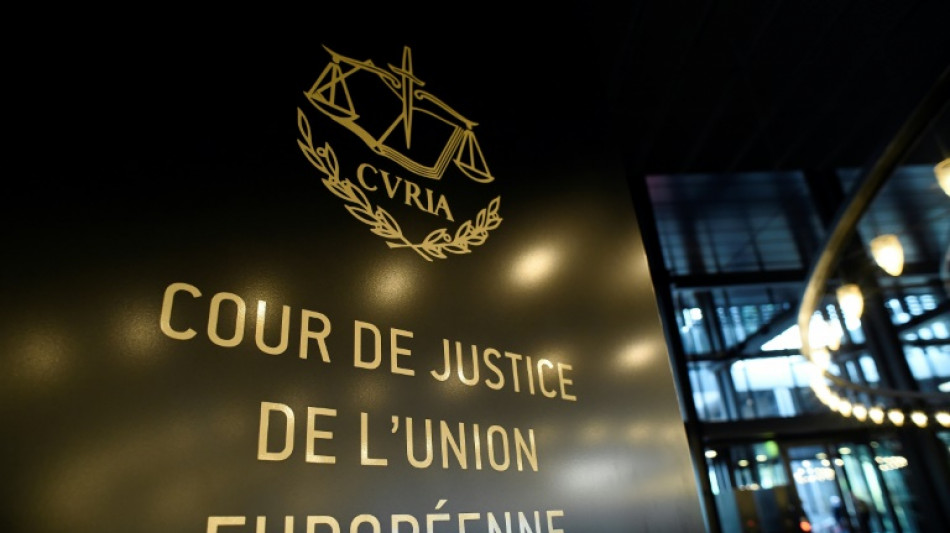
EU court to deliver key rule-of-law judgement

 Kenya's economy faces climate change risks: World Bank

 'Stop the slaughter': French farmers block roads over cow disease cull

 Why SpaceX IPO plan is generating so much buzz

 World stocks mostly slide, consolidating Fed-fuelled gains

 UK's king shares 'good news' that cancer treatment will be reduced in 2026

 Salah admired from afar in his Egypt home village as club tensions swirl

 Iran frees child bride sentenced to death over husband's killing: activists

 France updates net-zero plan, with fossil fuel phaseout

 EU agrees recycled plastic targets for cars

 British porn star fined, faces imminent Bali deportation

 Indonesia floods were 'extinction level' for rare orangutans

 Japan bear victim's watch shows last movements

 French indie 'Clair Obscur' dominates Game Awards

 Asian markets track Wall St record after Fed cut

 Vaccines do not cause autism: WHO

 'In her prime': Rare blooming of palm trees in Rio

 OpenAI beefs up GPT models in AI race with Google

 Cyclone causes blackout, flight chaos in Brazil's Sao Paulo

 US bringing seized tanker to port, as Venezuela war threats build

 Time magazine names 'Architects of AI' as Person of the Year

 OpenAI, Disney to let fans create AI videos in landmark deal

 Thyssenkrupp pauses steel production at two sites citing Asian pressure

 Stocks mixed as US rate cut offset by Fed outlook, Oracle earnings

 Breakout star: teenage B-girl on mission to show China is cool

 Austria set to vote on headscarf ban in schools

The EU's highest court will rule Wednesday on whether European Union funds can be slashed for member states flouting democratic standards, a case with major implications for Poland and Hungary.
Both EU countries -- which Brussels says are backsliding on rule of law -- launched the legal challenge being heard by the European Court of Justice (ECJ). They want the so-called "conditionality mechanism" to be invalidated.
But in December the court's advisor, the advocate general, concluded that the Polish-Hungarian challenge should be rejected, arguing that the conditionality mechanism was compatible with the EU's treaties.
Should the judges decide the same, it would open the door to the European Commission cutting their funding.
The European Parliament, which approves the EU's multi-year budgets, has for months called for the commission to do just that, stressing that the conditionality instrument has been available since the beginning of last year.
It has even launched its own legal action, accusing the commission of inaction.
But the EU executive, wary of being wrong-footed by court rulings and aware it needs a qualified majority of member states to approve the mechanism's use, has been determined to build a cast-iron case, step-by-step.
In November, it sent formal letters to Warsaw and Budapest setting out what it sees as the democratic shortfalls.
For Poland, it criticises judicial reforms it believes undermine judges' independence and a refusal to accept the primacy of EU law over Polish law.
For Hungary, it is about public procurement, conflict of interests and corruption.
- Live broadcast -
In a sign of how anticipated Wednesday's judgment is, the court will for the first time broadcast its ruling live.
That decision will then be debated in the European Parliament, where EU budget commissioner Johannes Hahn will stand in for commission chief Ursula von der Leyen, who pulled out to focus on the military crisis over Ukraine.
If the ECJ confirms the right to cut money on these grounds, "we expect the European Commission to start putting the mechanism into action right away", said the head of the conservative EPP bloc in the parliament, Manfred Weber.
Poland's Constitutional Court is due to issue its own conclusions on the EU conditionality mechanism on Thursday. The court is considered to be close to the ruling Law and Justice party that continues to defy Brussels.
If the ECJ ruling goes against Poland and Hungary, it is expected that both countries will throw up more legal challenges to try to overturn it.
The conditionality mechanism was created in 2020, after a summit at the height of the coronavirus pandemic that agreed common borrowing to build an 800-billion-euro ($900 billion) pile of grants and loans for EU countries to recover.
Budget hawks, including Austria and the Netherlands, demanded the conditionality mechanism to put guard rails around the spending of taxpayers' money.
St.Ch.Baker--CPN