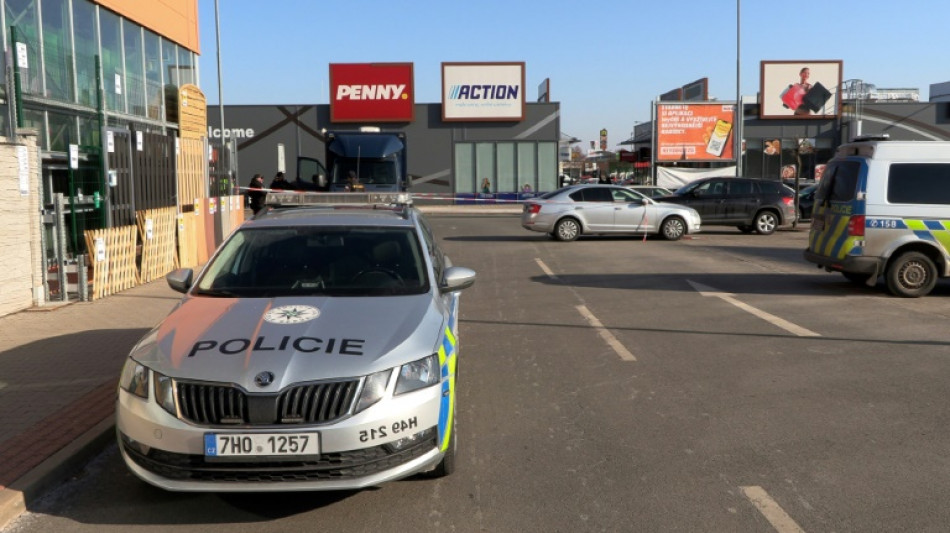
Peaceful Czechs grapple with youth violence / Photo: Jan FLEMR - AFP

 Kenya's economy faces climate change risks: World Bank

 'Stop the slaughter': French farmers block roads over cow disease cull

 Why SpaceX IPO plan is generating so much buzz

 World stocks mostly slide, consolidating Fed-fuelled gains

 UK's king shares 'good news' that cancer treatment will be reduced in 2026

 Salah admired from afar in his Egypt home village as club tensions swirl

 Iran frees child bride sentenced to death over husband's killing: activists

 France updates net-zero plan, with fossil fuel phaseout

 EU agrees recycled plastic targets for cars

 British porn star fined, faces imminent Bali deportation

 Indonesia floods were 'extinction level' for rare orangutans

 Japan bear victim's watch shows last movements

 French indie 'Clair Obscur' dominates Game Awards

 Asian markets track Wall St record after Fed cut

 Vaccines do not cause autism: WHO

 'In her prime': Rare blooming of palm trees in Rio

 OpenAI beefs up GPT models in AI race with Google

 Cyclone causes blackout, flight chaos in Brazil's Sao Paulo

 US bringing seized tanker to port, as Venezuela war threats build

 Time magazine names 'Architects of AI' as Person of the Year

 OpenAI, Disney to let fans create AI videos in landmark deal

 Thyssenkrupp pauses steel production at two sites citing Asian pressure

 Stocks mixed as US rate cut offset by Fed outlook, Oracle earnings

 Breakout star: teenage B-girl on mission to show China is cool

 Austria set to vote on headscarf ban in schools

When a 13-year-old boy pointed a gun at his teacher in a Czech school in January, she kept cool and slowly cornered him to let his classmates escape.
Police said she did everything right, using recent security training put in place as alarm has grown about bullying, attacks and even murders committed by schoolchildren.
"Violence and youth mental problems are growing dramatically at Czech schools," the education ministry said in a document sent to schools earlier this year to help them cope with potential dangers.
While experts warn that little data on youth violence across Europe exists, it has started to make headlines regularly in the central European country that ranks 12th safest on the Global Peace Index.
The index takes into account conflicts and militarisation but also levels of perceived criminality and number of homicides.
Even "within Europe, we are a peaceful country", sociologist Martin Buchtik told AFP.
He cited "indifference to religion", ethnic homogeneity, a "functioning social system" and a general distaste for "radical solutions" as factors that generally keep Czechs cool.
- Frightening attacks -
Since a student killed 14 people and wounded 25 at Prague's Charles University in December 2023 in a shooting that shocked the nation, Czech schools have stepped up prevention programmes and cooperation with the police.
But cases keep coming up.
Last month, a 16-year-old boy stabbed two shop assistants to death with a knife he picked up on a shelf in an apparently random attack.
Also in February, police charged a 15-year-old boy who threatened to open fire at an elementary school in a northern city.
And within five days in January, police detained 10 minors suspected of attempting or plotting attacks at schools across the country of 10.9 million people.
Minors committed 1,080 violent crimes including 10 murders in 2024, police statistics show, a sharp growth from 701 violent crimes and seven murders in 2022.
The number of juvenile delinquents in the EU country has grown by 26 percent from 2019 to 2024.
Likewise in neighbouring Austria as well as in Slovenia, which also rank high on the global peace index, youth crime statistics show a rise.
This is in part due to increased awareness which has led to a rise in reporting, as well as more types of offences being recorded, authorities say.
- Quarter 'feel no joy' -
Jan Zufnicek, a psychologist at the Prague-based Primary Prevention Centre, said in a podcast recently that "more than half of Czech children do not have an adult at school that they would confide in."
He said mental disorders among children were on the rise, fuelled by the Covid-19 pandemic and lockdowns.
A poll of over 10,000 children conducted by the Anreva Solution agency in Prague last year showed many children are battling depression, anxiety and a low sense of well-being.
More than a quarter of pupils polled felt no joy in life.
Forensic psychologist Ludmila Cirtkova blames "an accumulation of several unfavourable factors", saying young delinquents suffered from a lack of functioning relationships.
Cirtkova added the consumption of violence on the internet played a role too, a view echoed by the education ministry which blames "a massive spread" of digital technologies and social media.
Cirtkova sees a way out in "good relationships between educators and children".
"But it takes time and energy to show interest in the joys and worries of children," she added.
"If every part of the child socialisation system fulfils its role, I suppose the tragic cases of violent attacks will be absolutely rare."
Legal philosopher Theo Gavrielides, who works on youth violence prevention, also said young people should not be demonised.
"Young people and teenagers are in the state of development, hence there are a lot more things that can be done to prevent violence," he added.
P.Gonzales--CPN

