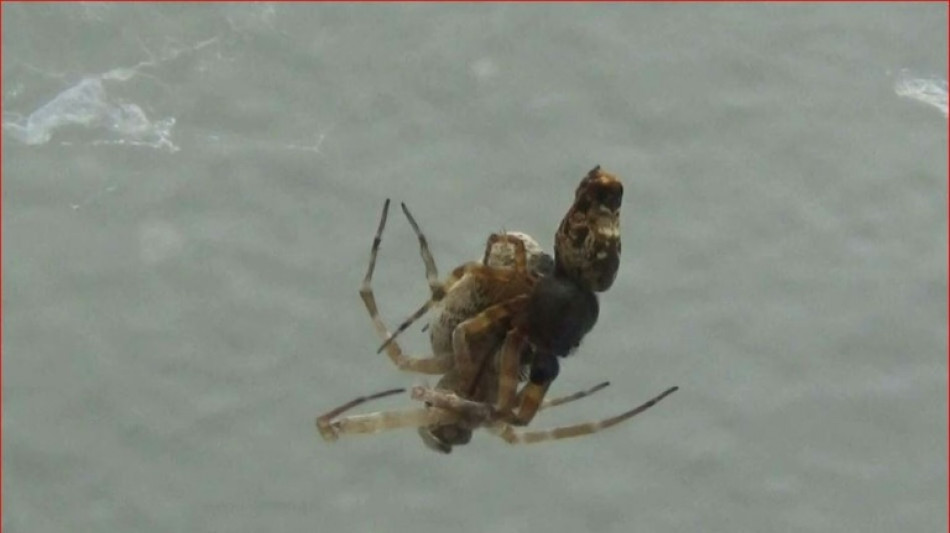
Some male spiders catapult away after sex to avoid death / Photo: Handout - Hubei University/AFP

 Kenya's economy faces climate change risks: World Bank

 Crypto firm Tether bids for Juventus, is quickly rebuffed

 Can Venezuela survive US targeting its oil tankers?

 World stocks retrench, consolidating Fed-fuelled gains

 World stocks consolidate Fed-fuelled gains

 Stocks rally in wake of Fed rate cut

 British porn star to be deported from Bali after small fine

 Spain opens doors to descendants of Franco-era exiles

 Thai teacher finds 'peace amidst chaos' painting bunker murals

 South Korea exam chief quits over complaints of too-hard tests

 South Korea exam chief resigns after tests dubbed too hard

 Laughing about science more important than ever: Ig Nobel founder

 Crypto mogul Do Kwon sentenced to 15 years for fraud: US media

 Make your own Mickey Mouse clip - Disney embraces AI

 Dark, wet, choppy: Machado's secret sea escape from Venezuela

 2024 Eurovision winner Nemo returns trophy over Israel's participation

 Make your own AI Mickey Mouse - Disney embraces new tech

 Floodworks on Athens 'oasis' a tough sell among locals

 German growth forecasts slashed, Merz under pressure

 ECB proposes simplifying rules for banks

 Desert dunes beckon for Afghanistan's 4x4 fans

 Chocolate prices high before Christmas despite cocoa fall

 Asian traders cheer US rate cut but gains tempered by outlook

 Oracle shares dive as revenue misses forecasts

 Divided US Fed makes third straight rate cut, signals higher bar ahead

Sometimes there are pretty valid reasons for leaving right after sex.
A team of Chinese scientists has discovered that male orb-weaving spiders fling themselves away from their partners -- pulling 20 Gs of acceleration in order to avoid being killed and eaten.
The mechanism, described for the first time in the journal Current Biology on Monday, involves the spiders' first pair of legs to immediately undertake a split-second catapult action.
Lead author Shichang Zhang of Hubei University in Wuhan told AFP he was "excited" to make the discovery, which required high-speed, high-resolution cameras to detect.
Zhang and colleagues were studying sexual selection in this spider, "Philoponella prominens," which live in communal groups of up to 300 individuals.
Of 155 successful matings, they found 152 ended with the male catapulting and thus surviving the encounter.
Males can mate up to six times with the same female -- bouncing off, climbing back up using a silk safety line, mating, and bouncing off again.
The three males that didn't catapult were promptly captured, killed and consumed by their partners.
Another 30 males that were prevented from catapulting by placing a fine brush behind their dorsum all met the same fate -- leading the researchers to conclude catapulting is essential to avoiding sexual cannabalism.
The escaping spiders clocked some impressive statistics: their average peak speed was 65 centimeters per second, with an acceleration of 200 meters per second squared. That's equivalent to 20 Gs, or 20 times the acceleration felt during freefall.
While soaring through the air, the males spin around at some 175 revolutions per second.
The males catapult by folding the tibia-metatarsus joint of their first leg pair against females. When released, it exerts hydraulic pressure and causes the legs to expand.
Zhang said he believes the females were judging males' sexual suitability by their ability to escape.
"Through the catapulting, a male can escape female sexual cannibalism, and a female can choose males with high quality, because the kinetic performance may directly correlate with male's physical condition," he said.
Even though they have already mated, females may go on to only accept the sperm of males that passed the test, explained Zhang.
Spiders differ from mammals in that females have a structure known as spermatheca where deposited sperm is stored. She can decide whether to use it to fertilize her eggs, or reject it by squeezing it out or changing the pH value to kill the sperm.
Future work will confirm whether there is a correlation between male catapulting and reproductive success, said Zhang.
O.Ignatyev--CPN