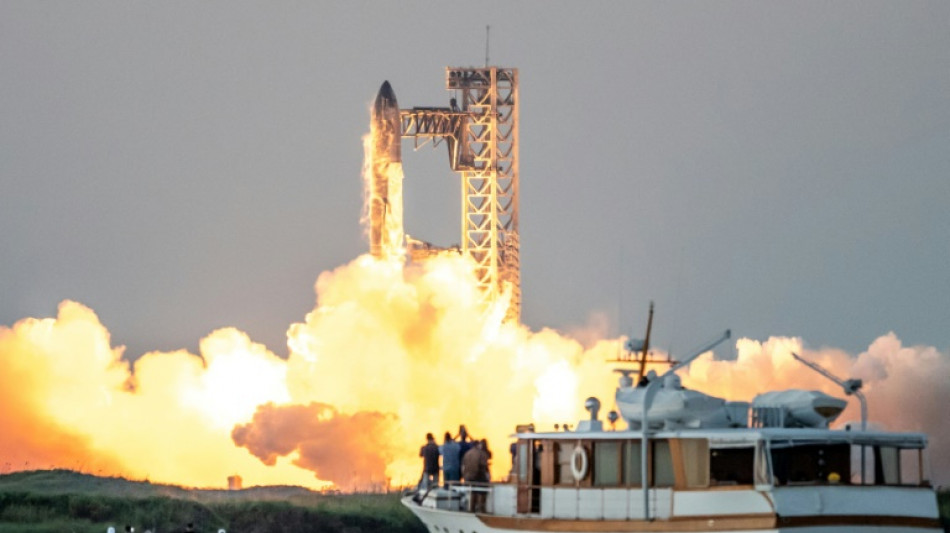
In milestone, SpaceX 'catches' megarocket booster after test flight
/ Photo: SERGIO FLORES - AFP

 Kenya's economy faces climate change risks: World Bank

 Crypto firm Tether bids for Juventus, is quickly rebuffed

 Can Venezuela survive US targeting its oil tankers?

 World stocks retrench, consolidating Fed-fuelled gains

 World stocks consolidate Fed-fuelled gains

 Stocks rally in wake of Fed rate cut

 British porn star to be deported from Bali after small fine

 Spain opens doors to descendants of Franco-era exiles

 Thai teacher finds 'peace amidst chaos' painting bunker murals

 South Korea exam chief quits over complaints of too-hard tests

 South Korea exam chief resigns after tests dubbed too hard

 Laughing about science more important than ever: Ig Nobel founder

 Crypto mogul Do Kwon sentenced to 15 years for fraud: US media

 Make your own Mickey Mouse clip - Disney embraces AI

 Dark, wet, choppy: Machado's secret sea escape from Venezuela

 2024 Eurovision winner Nemo returns trophy over Israel's participation

 Make your own AI Mickey Mouse - Disney embraces new tech

 Floodworks on Athens 'oasis' a tough sell among locals

 German growth forecasts slashed, Merz under pressure

 ECB proposes simplifying rules for banks

 Desert dunes beckon for Afghanistan's 4x4 fans

 Chocolate prices high before Christmas despite cocoa fall

 Asian traders cheer US rate cut but gains tempered by outlook

 Oracle shares dive as revenue misses forecasts

 Divided US Fed makes third straight rate cut, signals higher bar ahead

SpaceX on Sunday successfully flew the first-stage booster of its Starship megarocket back to the launch pad after a test flight, a technical tour de force that furthers the company's quest for rapid reusability.
The "super heavy booster" had blasted off attached to the uncrewed Starship rocket minutes earlier, then made a picture-perfect controlled return to the same pad in Texas, where a pair of huge mechanical "chopsticks" reached out from the launch tower to bring the slowly descending booster to a halt, according to a livestream from Elon Musk's SpaceX company.
Not long afterward, the upper stage of Starship splashed down, as planned, in the Indian Ocean, a development saluted by Musk on X.
"Ship landed precisely on target!" he said of the vehicle's fifth test flight. "Second of the two objectives achieved."
The successful "catching" of the booster at its Texas launch pad had company staffers erupting in cheers.
"Folks, this is a day for the engineering history books," a SpaceX spokesperson said on the company's livestream.
Liftoff occurred at 7:25 am (1225 GMT) in clear weather from the SpaceX facility in southern Texas.
During its last flight in June, SpaceX achieved its first successful splashdown with Starship, a prototype spaceship that Musk hopes will one day carry humans to Mars.
US space agency NASA, which congratulated SpaceX on its successful test, is also keenly awaiting a modified version of Starship to act as a lander vehicle for crewed flights to the Moon under the Artemis program later this decade.
SpaceX said its engineers have "spent years preparing and months testing for the booster catch attempt, with technicians pouring tens of thousands of hours into building the infrastructure to maximize our chances for success."
Teams were monitoring to ensure "thousands" of criteria were met both on the vehicle and at the tower before any attempt to return the booster.
Had the conditions not been satisfied, it would have been redirected for a splashdown in the Gulf of Mexico, as in previous tests.
Instead, having been given the green light, the returning booster decelerated from supersonic speeds and the powerful "chopstick arms" embraced it.
- 'Fail fast, learn fast' -
The large mechanical arms, called "Mechazilla" by Musk, have generated considerable excitement among space enthusiasts.
Video posted by SpaceX showed the booster slowly descending, its bottom wobbling slowly to and fro as some of its 33 powerful engines corrected its descent, until the arms closed gently around it and held the huge device in place above the ground.
Starship stands 397 feet (121 meters) tall with both stages combined -- about 90 feet taller than the Statue of Liberty.
Its Super Heavy booster, which is 233 feet tall, produces 16.7 million pounds (74.3 Meganewtons) of thrust, about twice as powerful as the Saturn V rockets used during the Apollo missions.
SpaceX's "fail fast, learn fast" strategy of rapid iterative testing, even when its rockets blow up spectacularly, has ultimately accelerated development and contributed to the company's success.
Founded only in 2002, it quickly leapfrogged aerospace industry giants and is now the world leader in orbital launches, besides providing the only US spaceship currently certified to carry astronauts.
It has also created the world's biggest internet satellite constellation -- invaluable in disaster and war zones.
But its founding vision of making humanity a multiplanetary species is increasingly at risk of being overshadowed by Musk's embrace of Republican presidential candidate Donald Trump and his alignment with right-wing politics.
A clearly energized Musk, wearing an "Occupy Mars" T-shirt, appeared alongside Trump at a recent rally in Pennsylvania.
The company has been openly sparring with the Federal Aviation Administration over launch licensing and alleged violations, with Musk accusing the agency of overreach and calling for its chief, Michael Whitaker, to resign.
"He's trying to position himself for minimal regulatory interference with SpaceX once Donald Trump becomes president," said Mark Hass, a marketing expert and professor at Arizona State University. "But it's a calculated gamble if things go the other way."
D.Goldberg--CPN