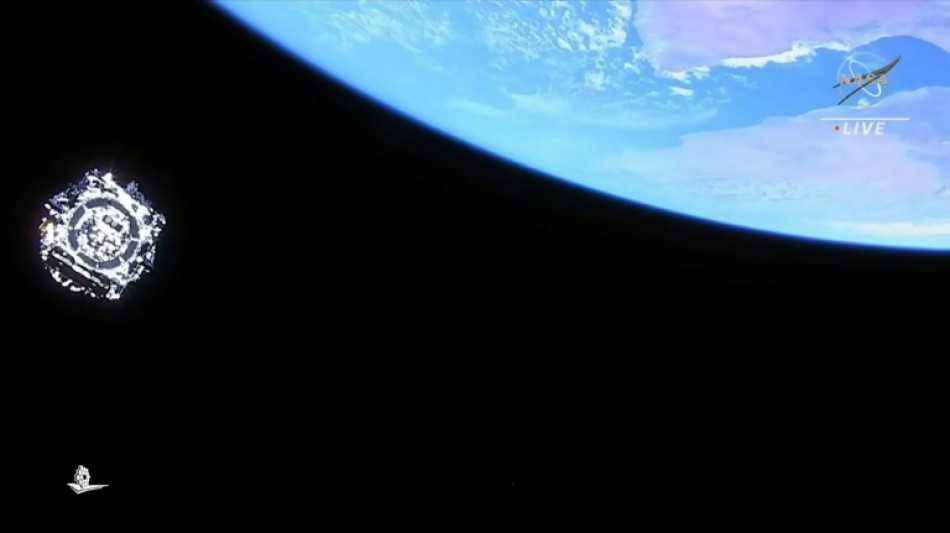
Webb telescope directly observes exoplanet CO2 for first time / Photo: - - NASA TV/AFP/File

 Kenya's economy faces climate change risks: World Bank

 'Stop the slaughter': French farmers block roads over cow disease cull

 Why SpaceX IPO plan is generating so much buzz

 World stocks mostly slide, consolidating Fed-fuelled gains

 UK's king shares 'good news' that cancer treatment will be reduced in 2026

 Salah admired from afar in his Egypt home village as club tensions swirl

 Iran frees child bride sentenced to death over husband's killing: activists

 France updates net-zero plan, with fossil fuel phaseout

 EU agrees recycled plastic targets for cars

 British porn star fined, faces imminent Bali deportation

 Indonesia floods were 'extinction level' for rare orangutans

 Japan bear victim's watch shows last movements

 French indie 'Clair Obscur' dominates Game Awards

 Asian markets track Wall St record after Fed cut

 Vaccines do not cause autism: WHO

 'In her prime': Rare blooming of palm trees in Rio

 OpenAI beefs up GPT models in AI race with Google

 Cyclone causes blackout, flight chaos in Brazil's Sao Paulo

 US bringing seized tanker to port, as Venezuela war threats build

 Time magazine names 'Architects of AI' as Person of the Year

 OpenAI, Disney to let fans create AI videos in landmark deal

 Thyssenkrupp pauses steel production at two sites citing Asian pressure

 Stocks mixed as US rate cut offset by Fed outlook, Oracle earnings

 Breakout star: teenage B-girl on mission to show China is cool

 Austria set to vote on headscarf ban in schools

The James Webb Space Telescope has directly observed the key chemical of carbon dioxide in planets outside of our solar system for the first time, scientists announced Monday.
The gas giants are not capable of hosting extraterrestrial life, but do offer clues in a lingering mystery about how distant planets form, according to a study in The Astrophysical Journal.
The HR 8799 system, 130 light years from Earth, is only 30 million years old -- just a baby compared to our solar system's 4.6 billion years.
A US-led team of researchers used Webb to directly detect carbon dioxide in the atmosphere of all four of the system's known planets, according to the study.
They used Webb's coronagraph instruments, which block the light from bright stars to get a better view of the planets revolving around them.
"It's like putting your thumb up in front of the Sun when you're looking up at the sky," lead study author William Balmer, an astrophysicist at Johns Hopkins University, told AFP.
Normally, the Webb telescope only detects exoplanets by glimpsing them when they cross in front of their host star.
This "transiting method" was how Webb indirectly detected CO2 in the atmosphere of the gas giant WASP-39 in 2022.
But for latest discovery, "we're actually seeing the light that is emitted from the planet itself, as opposed to the fingerprint of that light from the host star," Balmer said.
This is not easy -- Balmer compared the process to using a torch to spot fireflies next to a lighthouse.
While these gas giants may not be able to host life, it is possible that they had moons that could, he added.
There are missions currently under way to find out if there could be life in the vast oceans underneath the icy shells of several of Jupiter's moons.
- 'Key piece of proof' -
Carbon dioxide (CO2) is essential for life on Earth, making it a key target in the search for life elsewhere.
Because CO2 condenses into little ice particles in the deep cold of space, its presence can shed light on planetary formation.
Jupiter and Saturn are believed to have first formed from a "bottom up" process in which a bunch of tiny, icy particles came together into a solid core which then sucked in gas to grow into giants, Balmer said.
So the new discovery is a "key piece of proof" that far-off planets can form in a similar way to those in our celestial backyard, Balmer said.
But how common this is throughout the universe remains unclear.
Astronomers have now discovered nearly 6,000 exoplanets, many of them massive -- and none of them known to be habitable.
The "huge leap forward we need to make" is to focus on smaller Earth-sized worlds, Balmer said.
NASA's Nancy Grace Roman space telescope will use a coronagraph to do that just after its planned launch in 2027.
Balmer hopes to use Webb to observe more four-planet systems, but added that future funding was now in question.
Last week the Trump administration announced that NASA's chief scientist has been dismissed, indicating that more cuts were to come for the US space agency.
P.Kolisnyk--CPN