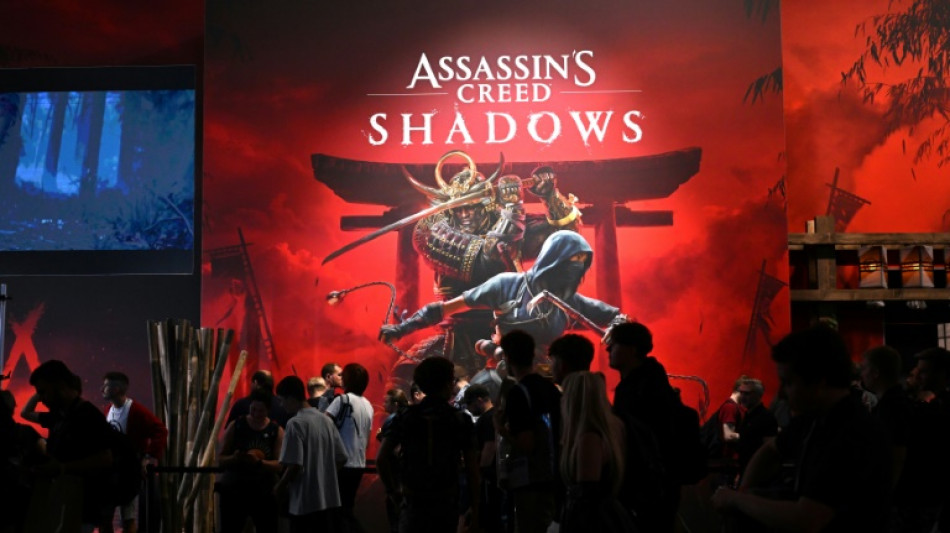
Historic fantasy 'Assassin's Creed' sparks bitter battles / Photo: Ina FASSBENDER - AFP/File

 Kenya's economy faces climate change risks: World Bank

 Crypto firm Tether bids for Juventus, is quickly rebuffed

 Can Venezuela survive US targeting its oil tankers?

 World stocks retrench, consolidating Fed-fuelled gains

 World stocks consolidate Fed-fuelled gains

 Stocks rally in wake of Fed rate cut

 British porn star to be deported from Bali after small fine

 Spain opens doors to descendants of Franco-era exiles

 Thai teacher finds 'peace amidst chaos' painting bunker murals

 South Korea exam chief quits over complaints of too-hard tests

 South Korea exam chief resigns after tests dubbed too hard

 Laughing about science more important than ever: Ig Nobel founder

 Crypto mogul Do Kwon sentenced to 15 years for fraud: US media

 Make your own Mickey Mouse clip - Disney embraces AI

 Dark, wet, choppy: Machado's secret sea escape from Venezuela

 2024 Eurovision winner Nemo returns trophy over Israel's participation

 Make your own AI Mickey Mouse - Disney embraces new tech

 Floodworks on Athens 'oasis' a tough sell among locals

 German growth forecasts slashed, Merz under pressure

 ECB proposes simplifying rules for banks

 Desert dunes beckon for Afghanistan's 4x4 fans

 Chocolate prices high before Christmas despite cocoa fall

 Asian traders cheer US rate cut but gains tempered by outlook

 Oracle shares dive as revenue misses forecasts

 Divided US Fed makes third straight rate cut, signals higher bar ahead

The "Assassin's Creed" series of video games is adored for painstaking historic accuracy, but also sparks controversy with heavy use of artistic license -- most recently with a black samurai in the latest instalment, "Shadows".
Released on Thursday, "Shadows" takes place in 16th-century feudal Japan, replete with imposing fortified cities and tranquil temples crafted by developers.
"They've done a really fantastic job with very accurate recreations," said Pierre-Francois Souyri, a historian among a dozen French and Japanese experts consulted for the game in a bid to weed out cliches and anachronisms.
Since being tapped in late 2021, Souyri says he has answered "a hundred or more questions" from the development team, ranging from how salt was produced to how puppet shows were staged.
Souyri adds that within the carefully crafted setting, "it's not too hard to come up with characters who find themselves having adventures" in "a very eventful period" marked by intense conflicts.
- Black samurai -
But one foundational choice by the creative team has provoked fierce debate online and beyond: casting a black samurai, Yasuke, as one of the two playable protagonists. The other is a young female ninja, Fujibayashi Naoe.
Irritation that an African character was depicted with the rank of samurai prompted a Japanese petition against the move, receiving more than 100,000 signatures.
The text blasted "lack of historical accuracy and cultural respect" by game developers.
Souyri was unimpressed by the criticism.
"It's the game's conceit to call him a samurai, it's not a doctoral thesis," he said.
Like other historians who have weighed in, he pointed out that Yasuke "is a person who really existed" -- although the historic evidence on his status "can be difficult to interpret".
Yuichi Gozai, assistant professor at the National Centre for Japanese Studies in Kyoto, disagreed.
"Nothing proves that Yasuke had such qualifications" making him a samurai, medieval history specialist Gozai said.
In surviving documents, "Yasuke stood out above all for the colour of his skin and his physical strength".
His patron, warlord Oda Nobunaga, likely "kept Yasuke by his side to show him off", Gozai believes.
Erupting even before "Shadows" had been released, the controversy over the black character's inclusion has been the fiercest surrounding any "Assassin's Creed" game.
The series has been attacked in the past, including by hard-left French politician Jean-Luc Melenchon for how firebrand Robespierre was depicted in "Assassin's Creed Unity", set during the French Revolution.
- Culture war battleground -
In a February report, the European Video Game Observatory noted that Ubisoft's announcement of Yasuke immediately "sparked a heated controversy amplified by social media".
The outfit blamed most of the uproar on "an American conservative moral crusade" waged by a hard core of "at least 728 interconnected accounts".
That group made up "only 0.8 percent of speakers on the topic of 'Assassin's Creed Shadows' in the US (but) account for 22.1 percent of all related coverage", the Observatory added.
The researchers said the behaviour "suggests an astroturfing campaign" that piggybacked on the broader culture-war battles going on during the US presidential election campaign.
"Our use of Yasuke has been instrumentalised by certain people to get their own message across... but that's not the message of the game," said Marc-Alexis Cote, executive producer of the "Assassin's Creed" franchise.
Nevertheless, within Japan depictions of the country's history remain a sensitive issue -- as shown by reactions to images showing a "Shadows" player damaging the interior of a temple.
"I understand France's secularist principles, but it's important to acknowledge that ill-considered insults about religion can spark strong reactions," Gozai said.
"This risk should have been foreseen."
Ubisoft itself had resisted for some time fans' demands to see an "Assassin's Creed" game set in Japan.
But recent successful games set in the feudal period, such as 2019's "Sekiro" or 2020's "Ghost of Tsushima", may have helped overcome the publisher's reticence.
"There's a combined effect of exoticism and familiarity which fascinates Westerners," historian Souyri said.
Many young people, especially in Western countries such as France and the United States, devour Japanese mangas and anime series.
But Gozai argues that "these depictions become counterproductive if they reinforce discrimination and prejudice towards Japan".
He calls "Shadows" a "clear example of these concerns being realised".
X.Wong--CPN