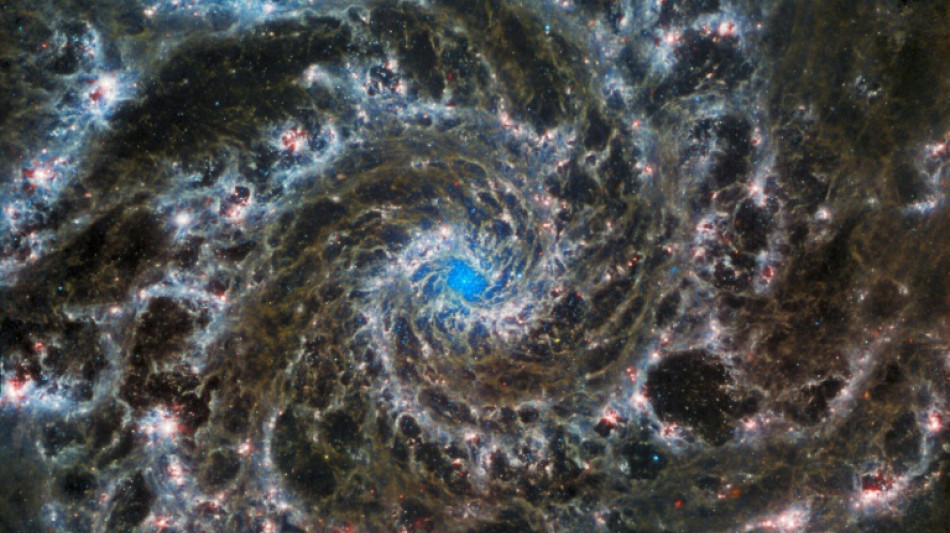
Webb telescope captures new detail of Phantom Galaxy / Photo: Handout - NASA/ESA/AFP

 Kenya's economy faces climate change risks: World Bank

 'Stop the slaughter': French farmers block roads over cow disease cull

 Why SpaceX IPO plan is generating so much buzz

 World stocks mostly slide, consolidating Fed-fuelled gains

 UK's king shares 'good news' that cancer treatment will be reduced in 2026

 Salah admired from afar in his Egypt home village as club tensions swirl

 Iran frees child bride sentenced to death over husband's killing: activists

 France updates net-zero plan, with fossil fuel phaseout

 EU agrees recycled plastic targets for cars

 British porn star fined, faces imminent Bali deportation

 Indonesia floods were 'extinction level' for rare orangutans

 Japan bear victim's watch shows last movements

 French indie 'Clair Obscur' dominates Game Awards

 Asian markets track Wall St record after Fed cut

 Vaccines do not cause autism: WHO

 'In her prime': Rare blooming of palm trees in Rio

 OpenAI beefs up GPT models in AI race with Google

 Cyclone causes blackout, flight chaos in Brazil's Sao Paulo

 US bringing seized tanker to port, as Venezuela war threats build

 Time magazine names 'Architects of AI' as Person of the Year

 OpenAI, Disney to let fans create AI videos in landmark deal

 Thyssenkrupp pauses steel production at two sites citing Asian pressure

 Stocks mixed as US rate cut offset by Fed outlook, Oracle earnings

 Breakout star: teenage B-girl on mission to show China is cool

 Austria set to vote on headscarf ban in schools

The James Webb space telescope has revealed dazzling new detail of a previously known slice of the cosmos 32 million light-years away, in a new picture released by NASA and the European Space Agency (ESA).
The infrared technology of the telescope, launched in December 2021, has allowed for an even clearer view of the so-called Phantom Galaxy than astronomers had ever seen before.
"Webb's sharp vision has revealed delicate filaments of gas and dust in the grandiose spiral arms which wind outwards from the center of this image," NASA and the ESA said Monday.
"A lack of gas in the nuclear region also provides an unobscured view of the nuclear star cluster at the galaxy's center," the agencies said in a statement.
The whirling celestial form, officially called M74, is located in the Pisces constellation 32 million light-years away from Earth.
The Webb image shows the galaxy's brilliant white, red, pink and light blue appendages of dust and stars swirling around a bright blue center, all set against the dark backdrop of deep space.
M74 was previously photographed by the Hubble telescope, which captured the galaxy's spiraling blue and pink arms, but instead showed its glowing center as a soft yellow.
The Phantom Galaxy is a "favorite target for astronomers studying the origin and structure of galactic spirals," NASA and the ESA said. The picture taken by Webb will help them "learn more about the earliest phases of star formation in the local Universe," and record more information about 19 star-forming galaxies close to our own Milky Way.
Astronomers will also use the picture to "pinpoint star-forming regions in the galaxies, accurately measure the masses and ages of star clusters, and gain insights into the nature of the small grains of dust drifting in interstellar space," the statement said.
Webb's new pictures have thrilled the space community as the telescope orbits the Sun at a distance of a million miles (1.6 million kilometers) from Earth, in a region of space called the second Lagrange point.
The telescope, which has a primary mirror more than 21 feet (6.5 meters) wide, is an international collaboration between NASA, the ESA and the Canadian Space Agency. It is expected to operate for approximately 20 years.
Ng.A.Adebayo--CPN