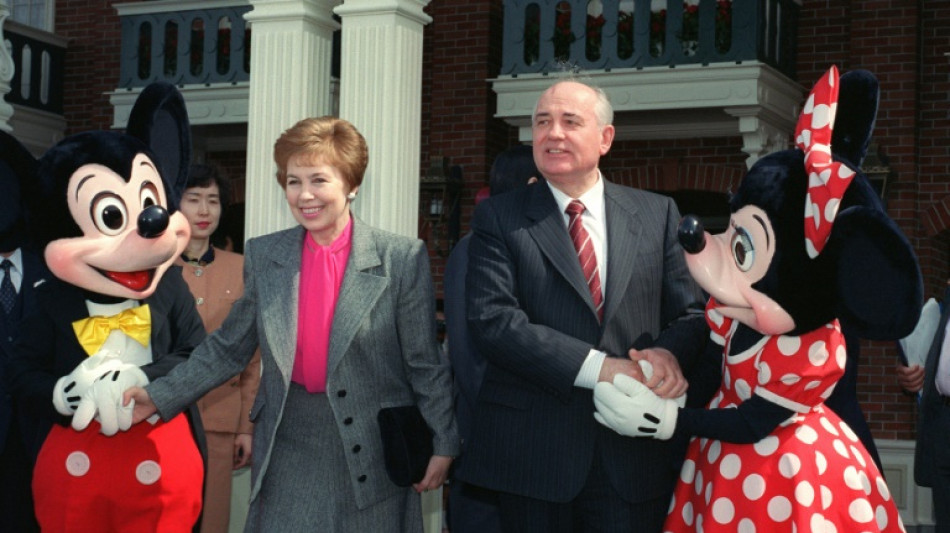
From Pizza Hut to the free press: Gorbachev's years after power / Photo: Yoshikazu TSUNO - AFP/File

 Kenya's economy faces climate change risks: World Bank

 'Stop the slaughter': French farmers block roads over cow disease cull

 Why SpaceX IPO plan is generating so much buzz

 World stocks mostly slide, consolidating Fed-fuelled gains

 UK's king shares 'good news' that cancer treatment will be reduced in 2026

 Salah admired from afar in his Egypt home village as club tensions swirl

 Iran frees child bride sentenced to death over husband's killing: activists

 France updates net-zero plan, with fossil fuel phaseout

 EU agrees recycled plastic targets for cars

 British porn star fined, faces imminent Bali deportation

 Indonesia floods were 'extinction level' for rare orangutans

 Japan bear victim's watch shows last movements

 French indie 'Clair Obscur' dominates Game Awards

 Asian markets track Wall St record after Fed cut

 Vaccines do not cause autism: WHO

 'In her prime': Rare blooming of palm trees in Rio

 OpenAI beefs up GPT models in AI race with Google

 Cyclone causes blackout, flight chaos in Brazil's Sao Paulo

 US bringing seized tanker to port, as Venezuela war threats build

 Time magazine names 'Architects of AI' as Person of the Year

 OpenAI, Disney to let fans create AI videos in landmark deal

 Thyssenkrupp pauses steel production at two sites citing Asian pressure

 Stocks mixed as US rate cut offset by Fed outlook, Oracle earnings

 Breakout star: teenage B-girl on mission to show China is cool

 Austria set to vote on headscarf ban in schools

A Soviet reformer, Mikhail Gorbachev continued to innovate after leaving the Kremlin -- as the first leader in Russia's modern history to play a public role in his years after power.
Tsars and Soviet leaders had for centuries died in their posts or, in the case of General Secretary Nikita Khrushchev, spent the end of their lives in obscurity after being forced from office.
Here is how Gorbachev carved his own post-power course over some three decades:
- Advertisements -
Gorbachev appeared in advertising campaigns for Western brands to raise money for his newly formed foundation, against the advice of some close to him.
Most notorious of these appearances was a Pizza Hut ad that saw the former president of the USSR walk across Red Square and into a franchise of the American chain.
Diners there are debating the legacy of Gorbachev's reforms, but finally rise to toast the ex-leader for bringing Pizza Hut to Russia.
A 2007 campaign for the luxury fashion brand Louis Vuitton showed Gorbachev looking out of a car at the Berlin Wall, with a monogrammed bag at his side and the slogan: "A journey brings us face to face with ourselves".
- Comeback attempt -
Gorbachev stood on a centrist platform in the 1996 presidential election but received less than one percent of the vote.
His long-time rival Boris Yeltsin, despite polling in the single digits in the months leading up to the poll, won hands down after securing the backing of media-controlling oligarchs.
The ex general secretary's drubbing may have ultimately served his cause, as it showed Yeltsin -- who had been seeking to rein in Gorbachev -- that he was no longer a political threat.
Gorbachev helped form a short-lived social democratic party at the turn of the millennium but never ran for office again.
- The international scene -
The ex-president followed the lead of many Western heads of state, with lucrative foreign lecture tours, a series of memoirs and a foundation in his name.
In 1992 Gorbachev also founded the international environmental NGO Green Cross. Long after leaving power, he continued to meet with world leaders to promote green causes.
He celebrated his 80th birthday in 2011 with a marathon charity gala at London's Albert Hall -- hosted by Sharon Stone and Kevin Spacey, and featuring tributes from the likes of Bono and Bill Clinton.
- The press -
The man who initiated the process of "glasnost", or openness, was in the 1990s an early investor in the opposition newspaper Novaya Gazeta.
The publication has been a platform for dissenting voices during President Vladimir Putin's rule and several of its staff, including investigative journalist Anna Politkovskaya, have been murdered for their reporting.
Gorbachev continued to give interviews and comment on global affairs until the end of his life.
Novaya Gazeta, whose chief editor Dmitry Muratov last year won the Nobel Peace Prize, suspended publication in late March until the end of Moscow's military intervention in Ukraine.
Russia's communications regulator in July demanded that the website and print edition of Novaya Gazeta be stripped of its licence.
- Family -
The great tragedy of Gorbachev's post-power life was the loss of his wife Raisa, who died of leukaemia in 1999 at the age of 67.
The last Soviet leader spent his final years in a modest country house to the west of Moscow, where he and Raisa had lived when they moved to the capital years earlier.
He lived with a housekeeper and a small security staff, according to press profiles and documentaries, coming into Moscow regularly for events and to visit his foundation.
L.Peeters--CPN