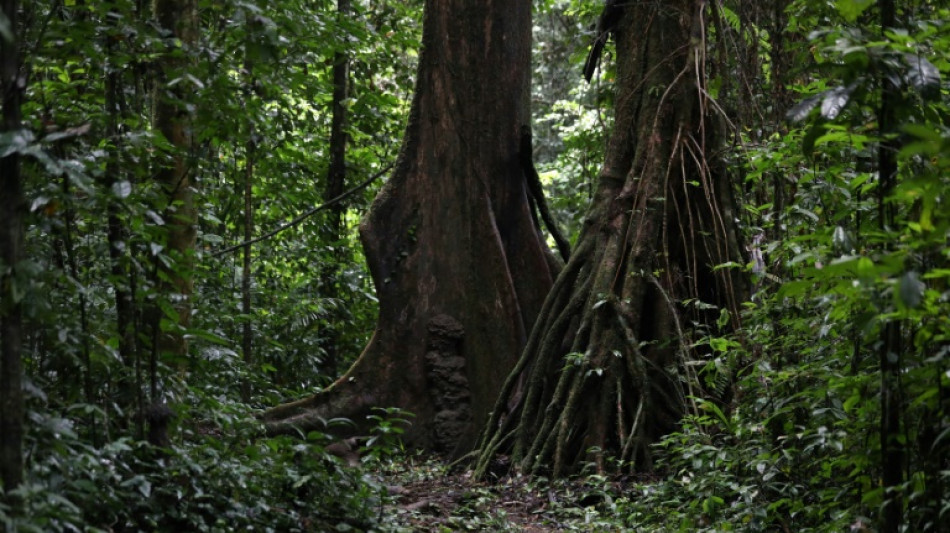
More than 9,000 tree species still undiscovered: study

 Kenya's economy faces climate change risks: World Bank

 Crypto firm Tether bids for Juventus, is quickly rebuffed

 Can Venezuela survive US targeting its oil tankers?

 World stocks retrench, consolidating Fed-fuelled gains

 World stocks consolidate Fed-fuelled gains

 Stocks rally in wake of Fed rate cut

 British porn star to be deported from Bali after small fine

 Spain opens doors to descendants of Franco-era exiles

 Thai teacher finds 'peace amidst chaos' painting bunker murals

 South Korea exam chief quits over complaints of too-hard tests

 South Korea exam chief resigns after tests dubbed too hard

 Laughing about science more important than ever: Ig Nobel founder

 Crypto mogul Do Kwon sentenced to 15 years for fraud: US media

 Make your own Mickey Mouse clip - Disney embraces AI

 Dark, wet, choppy: Machado's secret sea escape from Venezuela

 2024 Eurovision winner Nemo returns trophy over Israel's participation

 Make your own AI Mickey Mouse - Disney embraces new tech

 Floodworks on Athens 'oasis' a tough sell among locals

 German growth forecasts slashed, Merz under pressure

 ECB proposes simplifying rules for banks

 Desert dunes beckon for Afghanistan's 4x4 fans

 Chocolate prices high before Christmas despite cocoa fall

 Asian traders cheer US rate cut but gains tempered by outlook

 Oracle shares dive as revenue misses forecasts

 Divided US Fed makes third straight rate cut, signals higher bar ahead

Researchers estimate there are significantly more species of trees on Earth than currently known, with more than 9,000 species yet to be discovered, according to a study published Monday.
"Estimating the number of tree species is essential to inform, optimize, and prioritize forest conservation efforts across the globe," said the study, which was published in the US National Academy of Sciences journal PNAS and involved dozens of scientists.
About 64,100 tree species have already been identified.
But according to the study, which is based on a more complete database and uses a more advanced statistical method than previous ones, the total number of tree species is about 73,300 -- 14 percent more.
That means about 9,200 species have not yet been discovered.
Overall, the study said that "roughly" 43 percent of all tree species are found in South America, followed by Eurasia (22 percent), Africa (16 percent), North America (15 percent) and Oceania (11 percent).
Half to two-thirds of all known species are found in tropical or subtropical rainforests on five different continents, the researchers estimated.
A large proportion of the species yet to be discovered should therefore be found in these same regions, where fewer surveys are conducted.
Additionally, nearly a third of the world's tree species are scientifically classified as rare, with low populations in limited regions. These species are therefore more vulnerable to the threat of extinction.
Only 0.1 percent of species are found in all five of the regions identified by the study.
South America also has the highest proportion of endemic species, or species only present on that continent, at 49 percent.
"These results highlight the vulnerability of global tree species diversity," the study authors said, especially in the face of changes to the land due to human activity, and "future climate."
"Losing regions of forest that contain these rare species will have direct and potentially long-lasting impacts on the global species diversity and their provisioning of ecosystem services."
Species surveys are very time-consuming and present many challenges, including lack of access to certain areas and consistency of identification, and several botanists may characterize the same species slightly differently.
C.Peyronnet--CPN