-
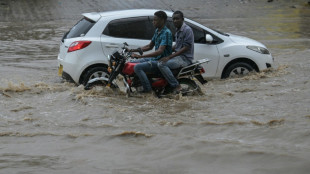 Kenya's economy faces climate change risks: World Bank
-
World stocks mostly slide, consolidating Fed-fuelled gains

-
 Crypto firm Tether bids for Juventus, is quickly rebuffed
-
UK's king shares 'good news' that cancer treatment will be reduced in 2026

-
 Can Venezuela survive US targeting its oil tankers?
-
Salah admired from afar in his Egypt home village as club tensions swirl

-
 World stocks retrench, consolidating Fed-fuelled gains
-
Iran frees child bride sentenced to death over husband's killing: activists

-
 World stocks consolidate Fed-fuelled gains
-
France updates net-zero plan, with fossil fuel phaseout

-
 Stocks rally in wake of Fed rate cut
-
EU agrees recycled plastic targets for cars

-
 British porn star to be deported from Bali after small fine
-
British porn star fined, faces imminent Bali deportation

-
 Spain opens doors to descendants of Franco-era exiles
-
Indonesia floods were 'extinction level' for rare orangutans

-
 Thai teacher finds 'peace amidst chaos' painting bunker murals
-
Japan bear victim's watch shows last movements

-
 South Korea exam chief quits over complaints of too-hard tests
-
French indie 'Clair Obscur' dominates Game Awards

-
 South Korea exam chief resigns after tests dubbed too hard
-
Asian markets track Wall St record after Fed cut

-
 Laughing about science more important than ever: Ig Nobel founder
-
Vaccines do not cause autism: WHO

-
 Crypto mogul Do Kwon sentenced to 15 years for fraud: US media
-
'In her prime': Rare blooming of palm trees in Rio

-
 Make your own Mickey Mouse clip - Disney embraces AI
-
OpenAI beefs up GPT models in AI race with Google

-
 Dark, wet, choppy: Machado's secret sea escape from Venezuela
-
Cyclone causes blackout, flight chaos in Brazil's Sao Paulo

-
 2024 Eurovision winner Nemo returns trophy over Israel's participation
-
US bringing seized tanker to port, as Venezuela war threats build

-
 Make your own AI Mickey Mouse - Disney embraces new tech
-
Time magazine names 'Architects of AI' as Person of the Year

-
 Floodworks on Athens 'oasis' a tough sell among locals
-
OpenAI, Disney to let fans create AI videos in landmark deal

-
 German growth forecasts slashed, Merz under pressure
-
Thyssenkrupp pauses steel production at two sites citing Asian pressure

-
 ECB proposes simplifying rules for banks
-
Stocks mixed as US rate cut offset by Fed outlook, Oracle earnings

-
 Desert dunes beckon for Afghanistan's 4x4 fans
-
Breakout star: teenage B-girl on mission to show China is cool

-
 Chocolate prices high before Christmas despite cocoa fall
-
Austria set to vote on headscarf ban in schools

-
 Asian traders cheer US rate cut but gains tempered by outlook
-
AI's $400 bn problem: Are chips getting old too fast?

-
 Oracle shares dive as revenue misses forecasts
-
US stocks rise, dollar retreats as Fed tone less hawkish than feared

-
 Divided US Fed makes third straight rate cut, signals higher bar ahead
-
Machado to come out of hiding after missing Nobel ceremony

NYSE - LSE
Ishiba's Plan to Change Power in Asia
Is Japan Preparing for War? Ishiba's Vision to Redefine Power in Asia
In a world where geopolitical tensions are intensifying, Japan finds itself at a crossroads. At the centre of this discussion is Shigeru Ishiba, a prominent Japanese politician and former defence minister, whose bold proposals to reshape Japan's security policies are sparking widespread debate. Is Japan merely safeguarding its sovereignty, or is it actively preparing for conflict?
A Paradigm Shift in Japanese Defence
Since the end of World War II, Japan has adhered strictly to its pacifist constitution, particularly Article 9, which renounces the use of war as a means of settling international disputes. However, as global power dynamics evolve and regional threats grow, Ishiba and other leaders argue that Japan must modernise its approach to defence.
Ishiba has proposed a significant expansion of Japan’s military capabilities, including increased defence spending, the development of advanced technologies such as missile defence systems, and a shift towards a proactive deterrence strategy. These measures, he asserts, are necessary to counter the rising influence of China and North Korea's nuclear threat.
The Strategic Context: Asia in Flux
Japan’s strategic positioning in Asia has long been a delicate balancing act. With China's growing assertiveness in the South China Sea, Taiwan Strait, and East China Sea, Ishiba’s call for a stronger Japanese military aims to counterbalance Beijing’s influence. North Korea’s missile tests and unpredictable behaviour further exacerbate the urgency for a robust Japanese defence policy.
Ishiba’s proposals align with the broader trend of Indo-Pacific nations strengthening security alliances, including Japan's growing collaboration with the United States, Australia, and India under the Quadrilateral Security Dialogue (Quad). These partnerships are seen as essential to maintaining regional stability and ensuring a free and open Indo-Pacific.
Domestic and International Reactions
Domestically, Ishiba’s vision has faced both support and opposition. Proponents argue that his policies are pragmatic and essential for Japan’s survival in an increasingly volatile region. Critics, however, worry that such moves could escalate tensions and provoke adversaries. The debate also revives questions about the reinterpretation of Japan’s pacifist constitution and its implications for national identity.
On the international stage, Ishiba’s stance has drawn mixed reactions. Allies like the United States welcome Japan’s increased commitment to regional security, while China and North Korea view these developments as provocative and destabilising.
Preparing for Conflict or Preserving Peace?
Ishiba has repeatedly emphasised that his aim is not to prepare for war but to prevent it. He argues that a strong deterrent capability is the best way to avoid conflict and maintain peace in the region. However, critics contend that expanding Japan's military footprint could trigger an arms race and inadvertently increase the likelihood of confrontation.
The Road Ahead
As Japan navigates these turbulent waters, Ishiba’s vision represents a pivotal moment in the country’s post-war history. Whether his proposals will redefine Japan’s role in Asia or exacerbate regional tensions remains to be seen. What is certain, however, is that Japan’s future decisions will have profound implications not only for its own security but for the broader balance of power in Asia.
As the world watches, the question remains: Is Japan preparing for war, or is it merely adapting to a new era of uncertainty? In answering this question, the nation must grapple with the delicate balance between safeguarding its future and upholding the ideals that have defined its modern identity.

Bolivia at breaking point

Embraer’s 950% surge

China’s profitless push

Alert in Trump’s America

Why China props up Putin

Zelenskyy anti-graft gamble

Seven-Day Sanctions Showdown

Trump vs. EU: A good deal?
Japan's financial precipice
Iraq vs. Iran – The end?

France's debt is growing