-
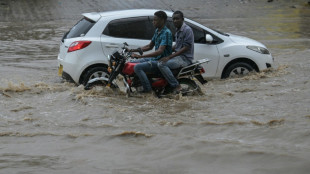 Kenya's economy faces climate change risks: World Bank
-
Campaigning starts in Central African Republic quadruple election

-
 'Stop the slaughter': French farmers block roads over cow disease cull
-
First urban cable car unveiled outside Paris

-
 Why SpaceX IPO plan is generating so much buzz
-
US unseals warrant for tanker seized off Venezuelan coast

-
 World stocks mostly slide, consolidating Fed-fuelled gains
-
Crypto firm Tether bids for Juventus, is quickly rebuffed

-
 UK's king shares 'good news' that cancer treatment will be reduced in 2026
-
Can Venezuela survive US targeting its oil tankers?

-
 Salah admired from afar in his Egypt home village as club tensions swirl
-
World stocks retrench, consolidating Fed-fuelled gains

-
 Iran frees child bride sentenced to death over husband's killing: activists
-
World stocks consolidate Fed-fuelled gains

-
 France updates net-zero plan, with fossil fuel phaseout
-
Stocks rally in wake of Fed rate cut

-
 EU agrees recycled plastic targets for cars
-
British porn star to be deported from Bali after small fine

-
 British porn star fined, faces imminent Bali deportation
-
Spain opens doors to descendants of Franco-era exiles

-
 Indonesia floods were 'extinction level' for rare orangutans
-
Thai teacher finds 'peace amidst chaos' painting bunker murals

-
 Japan bear victim's watch shows last movements
-
South Korea exam chief quits over complaints of too-hard tests

-
 French indie 'Clair Obscur' dominates Game Awards
-
South Korea exam chief resigns after tests dubbed too hard

-
 Asian markets track Wall St record after Fed cut
-
Laughing about science more important than ever: Ig Nobel founder

-
 Vaccines do not cause autism: WHO
-
Crypto mogul Do Kwon sentenced to 15 years for fraud: US media

-
 'In her prime': Rare blooming of palm trees in Rio
-
Make your own Mickey Mouse clip - Disney embraces AI

-
 OpenAI beefs up GPT models in AI race with Google
-
Dark, wet, choppy: Machado's secret sea escape from Venezuela

-
 Cyclone causes blackout, flight chaos in Brazil's Sao Paulo
-
2024 Eurovision winner Nemo returns trophy over Israel's participation

-
 US bringing seized tanker to port, as Venezuela war threats build
-
Make your own AI Mickey Mouse - Disney embraces new tech

-
 Time magazine names 'Architects of AI' as Person of the Year
-
Floodworks on Athens 'oasis' a tough sell among locals

-
 OpenAI, Disney to let fans create AI videos in landmark deal
-
German growth forecasts slashed, Merz under pressure

-
 Thyssenkrupp pauses steel production at two sites citing Asian pressure
-
ECB proposes simplifying rules for banks

-
 Stocks mixed as US rate cut offset by Fed outlook, Oracle earnings
-
Desert dunes beckon for Afghanistan's 4x4 fans

-
 Breakout star: teenage B-girl on mission to show China is cool
-
Chocolate prices high before Christmas despite cocoa fall

-
 Austria set to vote on headscarf ban in schools
-
Asian traders cheer US rate cut but gains tempered by outlook

NYSE - LSE
Canada challenges Trump on Tariffs
In a bold and unprecedented escalation of tensions between Canada and the United States, Prime Minister Justin Trudeau has launched a vigorous counter-offensive against U.S. President Donald Trump’s imposition of sweeping tariffs on Canadian goods. This retaliatory stance marks a significant shift in the historically amicable relationship between the two North American neighbours, igniting what Trudeau has termed a "trade war" that threatens to disrupt one of the world’s most integrated economic partnerships.
The genesis of this dispute lies in Trump’s decision, enacted on February 1, 2025, to impose a 25 per cent tariff on virtually all Canadian exports to the United States, alongside a 10 per cent levy on Canadian energy products. The White House justified these measures as a response to alleged failures by Canada to curb the flow of fentanyl across the border—a claim Trudeau has dismissed as "completely bogus, completely unjustified, completely false." Official U.S. data supports Canada’s position, revealing that less than 1 per cent of fentanyl intercepted at the U.S. border originates from its northern neighbour.
In response, Trudeau announced retaliatory tariffs on March 4, targeting C$155 billion (approximately US$107 billion) worth of American goods. The first phase, effective immediately, imposes a 25 per cent tariff on C$30 billion of U.S. imports, including consumer staples such as orange juice, peanut butter, and coffee. A second tranche, set to apply to C$125 billion of additional goods—ranging from passenger vehicles to steel products—will take effect within 21 days unless the U.S. reverses its policy. "We don’t want to be here, we didn’t ask for this, but we will not back down in standing up for Canadians," Trudeau declared in a press conference from Parliament Hill.
The Canadian leader has not minced words in his criticism of Trump’s strategy. Addressing the U.S. President directly, Trudeau remarked, "Even though you’re a very smart guy, this is a very dumb thing to do," echoing a Wall Street Journal editorial that branded the tariffs "the dumbest trade war in history." He further accused Trump of pursuing a deliberate agenda to destabilise Canada’s economy, suggesting that the ultimate aim might be to weaken the nation sufficiently to facilitate annexation—a notion Trump has repeatedly floated, mockingly referring to Trudeau as the "governor" of a hypothetical 51st state.
This tariff tit-for-tat has galvanised Canadian resolve across political and regional lines. Ontario Premier Doug Ford, a key figure in Canada’s economic heartland, has vowed to "make sure Americans feel pain," announcing a ban on U.S.-made alcohol in provincial liquor stores and threatening a 25 per cent surcharge on electricity exports to New York, Michigan, and Minnesota if U.S. tariffs persist. Quebec and Ontario have joined the fray by pulling American products from their shelves, while Conservative Leader Pierre Poilievre has urged a "Canada First" approach, advocating dollar-for-dollar retaliation to protect Canadian workers and businesses.
The economic stakes are staggering. Canada exports roughly 75 per cent of its goods to the United States, including C$75 billion in automotive products annually. Economists warn that a protracted trade war could plunge Canada into recession, with the Bank of Canada predicting "severe" and potentially irreversible consequences. Yet the fallout is not unilateral: American consumers face higher prices for groceries, fuel, and vehicles, while U.S. businesses reliant on Canadian materials brace for supply chain disruptions.
Trudeau has sought to rally national unity, urging Canadians to "redouble their efforts" in supporting domestic industries and rejecting American goods. "Canadians are hurt, angry, and frustrated," he acknowledged, pointing to symbolic acts of defiance such as the booing of the U.S. national anthem at sporting events. Yet he remains steadfast: "We are Canadians. We are going to fight, and we are going to win."
Internationally, Canada plans to challenge the tariffs through the World Trade Organization and the U.S.-Mexico-Canada Agreement (USMCA), a pact Trump himself negotiated during his first term. Meanwhile, Trump has doubled down, warning via social media that any Canadian retaliation will be met with "immediate reciprocal tariffs of the same size." This brinkmanship has drawn parallels to a broader global trade conflict, with Mexico and China also imposing countermeasures against U.S. tariffs of 25 per cent and 20 per cent, respectively.
As Trudeau prepares to step down later this month—his Liberal Party set to select a new leader on March 23—he leaves behind a nation galvanised by adversity. His successor will inherit a complex battle, one that tests Canada’s economic resilience and its sovereignty against an unpredictable adversary. For now, the message from Ottawa is clear: Canada will not yield. As Trudeau put it, "This is the time to stand together. Canada remains the best country in the world."
Trump’s Ukraine Economic Colony Plan Stirs Debate
China Targets Dollar at US Critical Moment
EU Pledges €800 Billion for Defence to Deter Russia
Israel escalates War to crush Hamas
Trump, Putin and the question: What now?
Nuclear weapons for Poland against Russia?
Rebellion against Trump: "Ready for War?"

Ukraine: Problem with the ceasefire?

Ukraine Loses Kursk: A Collapse?
Russia's "Alliance" in the Balkans is sinking
US Federal Reserve with “announcement”