
-
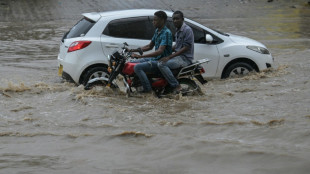 Kenya's economy faces climate change risks: World Bank
-
World stocks mostly slide, consolidating Fed-fuelled gains

-
 Crypto firm Tether bids for Juventus, is quickly rebuffed
-
UK's king shares 'good news' that cancer treatment will be reduced in 2026

-
 Can Venezuela survive US targeting its oil tankers?
-
Salah admired from afar in his Egypt home village as club tensions swirl

-
 World stocks retrench, consolidating Fed-fuelled gains
-
Iran frees child bride sentenced to death over husband's killing: activists

-
 World stocks consolidate Fed-fuelled gains
-
France updates net-zero plan, with fossil fuel phaseout

-
 Stocks rally in wake of Fed rate cut
-
EU agrees recycled plastic targets for cars

-
 British porn star to be deported from Bali after small fine
-
British porn star fined, faces imminent Bali deportation

-
 Spain opens doors to descendants of Franco-era exiles
-
Indonesia floods were 'extinction level' for rare orangutans

-
 Thai teacher finds 'peace amidst chaos' painting bunker murals
-
Japan bear victim's watch shows last movements

-
 South Korea exam chief quits over complaints of too-hard tests
-
French indie 'Clair Obscur' dominates Game Awards

-
 South Korea exam chief resigns after tests dubbed too hard
-
Asian markets track Wall St record after Fed cut

-
 Laughing about science more important than ever: Ig Nobel founder
-
Vaccines do not cause autism: WHO

-
 Crypto mogul Do Kwon sentenced to 15 years for fraud: US media
-
'In her prime': Rare blooming of palm trees in Rio

-
 Make your own Mickey Mouse clip - Disney embraces AI
-
OpenAI beefs up GPT models in AI race with Google

-
 Dark, wet, choppy: Machado's secret sea escape from Venezuela
-
Cyclone causes blackout, flight chaos in Brazil's Sao Paulo

-
 2024 Eurovision winner Nemo returns trophy over Israel's participation
-
US bringing seized tanker to port, as Venezuela war threats build

-
 Make your own AI Mickey Mouse - Disney embraces new tech
-
Time magazine names 'Architects of AI' as Person of the Year

-
 Floodworks on Athens 'oasis' a tough sell among locals
-
OpenAI, Disney to let fans create AI videos in landmark deal

-
 German growth forecasts slashed, Merz under pressure
-
Thyssenkrupp pauses steel production at two sites citing Asian pressure

-
 ECB proposes simplifying rules for banks
-
Stocks mixed as US rate cut offset by Fed outlook, Oracle earnings

-
 Desert dunes beckon for Afghanistan's 4x4 fans
-
Breakout star: teenage B-girl on mission to show China is cool

-
 Chocolate prices high before Christmas despite cocoa fall
-
Austria set to vote on headscarf ban in schools

-
 Asian traders cheer US rate cut but gains tempered by outlook
-
AI's $400 bn problem: Are chips getting old too fast?

-
 Oracle shares dive as revenue misses forecasts
-
US stocks rise, dollar retreats as Fed tone less hawkish than feared

-
 Divided US Fed makes third straight rate cut, signals higher bar ahead
-
Machado to come out of hiding after missing Nobel ceremony

NYSE - LSE
DOGE Fails to Slash U.S. Spending
The Department of Government Efficiency (DOGE), launched with bold promises to revolutionize federal spending, has fallen dramatically short of its ambitious goals, raising questions about its effectiveness and impact on the U.S. budget. Tasked with streamlining government operations and slashing what its proponents called wasteful expenditure, DOGE was heralded as a transformative force. Yet, recent developments reveal a stark reality: the initiative has failed to deliver meaningful spending cuts, leaving its lofty objectives unfulfilled and critics pointing to mismanagement and inflated claims.
Initially, DOGE set out with a headline-grabbing target of reducing federal spending by $2 trillion, a figure that captured public attention and underscored the initiative’s audacious vision. This goal was later halved to $1 trillion, signaling early challenges in identifying viable cuts without disrupting essential services. More recently, reports indicate that the projected savings have dwindled to a fraction of the original promise, with estimates suggesting only $150 billion in reductions—a mere 7.5% of the initial target. Even this figure has faced scrutiny, with analysts arguing that the actual savings may be significantly lower due to questionable accounting methods and speculative projections.
One of the core issues plaguing DOGE has been its approach to identifying efficiencies. The initiative aimed to eliminate redundant contracts, streamline federal agencies, and reduce bureaucratic overhead. However, the execution has been chaotic, with cuts often appearing indiscriminate rather than strategic. For instance, reductions in consulting contracts, particularly in defense and IT services, were touted as major wins, yet many of these contracts supported critical government functions. The abrupt termination of such agreements has led to operational disruptions, forcing agencies to scramble for alternatives or reinstate services at additional cost.
Moreover, DOGE’s efforts have sparked unintended consequences across federal agencies. Staff reductions, intended to shrink the workforce, have instead triggered inefficiencies, with remaining employees struggling to handle increased workloads. This has been particularly evident in agencies responsible for public services, where understaffing has led to delays and diminished service quality. The ripple effects extend beyond government operations, impacting private-sector contractors who relied on federal partnerships. Layoffs in consulting firms and other industries tied to government contracts have further eroded confidence in DOGE’s strategy.
Critics argue that DOGE’s aggressive push for cuts overlooked the complexity of federal budgeting. Many targeted programs, such as grants for cultural institutions or international development, represent a tiny fraction of the budget but deliver outsized benefits in terms of public goodwill and long-term economic gains. Eliminating these programs has yielded negligible savings while generating significant backlash. Similarly, attempts to overhaul agencies like the Social Security Administration have raised alarms about potential disruptions to benefits, undermining public trust in the initiative’s priorities.
The leadership behind DOGE has also come under fire. High-profile figures driving the initiative were expected to bring private-sector ingenuity to government reform. Instead, their lack of experience in public administration has led to missteps, including overestimating the ease of implementing cuts and underestimating the resistance from entrenched bureaucratic systems. Public perception has soured as well, with polls indicating growing skepticism about DOGE’s ability to deliver on its promises without harming essential services.
Financially, the broader context paints a grim picture. While DOGE aimed to curb deficits, the federal debt continues to climb, projected to exceed $36 trillion in the coming years. Tax cuts passed concurrently with DOGE’s efforts are expected to add trillions more to the deficit, offsetting any savings the initiative might achieve. This contradiction has fueled accusations that DOGE was more about political optics than genuine fiscal responsibility.
Looking ahead, DOGE’s future remains uncertain. With its initial timeline nearing its end, pressure is mounting to demonstrate tangible results. Supporters argue that the initiative has at least sparked a conversation about government waste, laying the groundwork for future reforms. However, without a clear pivot to more targeted, evidence-based strategies, DOGE risks being remembered as a cautionary tale of overambition and underdelivery.
In the end, the Department of Government Efficiency has not lived up to its billing as a budget-cutting juggernaut. Its inability to achieve meaningful spending reductions, coupled with operational missteps and public skepticism, underscores the challenges of reforming a sprawling federal system. As the U.S. grapples with fiscal challenges, the DOGE experiment serves as a reminder that bold promises must be matched by careful execution.

A new vision for Japan

The Fall of South Korea?

Gaza on the cusp of civil war

Israel: Economy on the edge

Why Russia can’t end war

Rare Earth Standoff

Tanks in Gaza - Hopes dim?

Poland trusts only hard Power

Cuba's hunger Crisis deepens

How Swiss Stocks tamed Prices

Russia's Drone ploy in Poland



