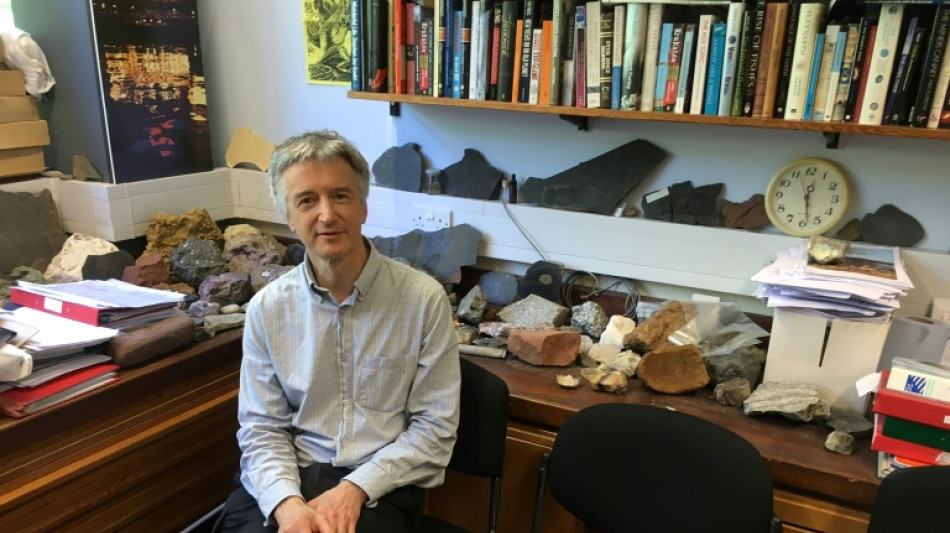
How the weight of the world fell on one geologist's shoulders / Photo: YASMIN YONAN - JAN ZALASIEWICZ/AFP

 Kenya's economy faces climate change risks: World Bank

 Crypto firm Tether bids for Juventus, is quickly rebuffed

 Can Venezuela survive US targeting its oil tankers?

 World stocks retrench, consolidating Fed-fuelled gains

 World stocks consolidate Fed-fuelled gains

 Stocks rally in wake of Fed rate cut

 British porn star to be deported from Bali after small fine

 Spain opens doors to descendants of Franco-era exiles

 Thai teacher finds 'peace amidst chaos' painting bunker murals

 South Korea exam chief quits over complaints of too-hard tests

 South Korea exam chief resigns after tests dubbed too hard

 Laughing about science more important than ever: Ig Nobel founder

 Crypto mogul Do Kwon sentenced to 15 years for fraud: US media

 Make your own Mickey Mouse clip - Disney embraces AI

 Dark, wet, choppy: Machado's secret sea escape from Venezuela

 2024 Eurovision winner Nemo returns trophy over Israel's participation

 Make your own AI Mickey Mouse - Disney embraces new tech

 Floodworks on Athens 'oasis' a tough sell among locals

 German growth forecasts slashed, Merz under pressure

 ECB proposes simplifying rules for banks

 Desert dunes beckon for Afghanistan's 4x4 fans

 Chocolate prices high before Christmas despite cocoa fall

 Asian traders cheer US rate cut but gains tempered by outlook

 Oracle shares dive as revenue misses forecasts

 Divided US Fed makes third straight rate cut, signals higher bar ahead

In 1981, newly minted palaeobiologist Jan Zalasiewicz assumed he was headed for a discreet career retrieving and deciphering fossils from Earth's deep past.
For three decades the British scientist was, in his words, an itinerant geologist.
But then, curiosity and happenstance thrust him into the middle of a raging debate within science and beyond as to whether human activity and appetites have tilted our planet into a new geological epoch, the Anthropocene.
Zalasiewicz was tapped in 2009 by the International Commission on Stratigraphy (ICS) -- guardians of the timescale dividing Earth's history into segments such as the Jurassic and Cretaceous -- to chair a working group on the issue.
"I was ambushed by the Anthropocene, and then kidnapped without hope of release," he told AFP in an interview.
The working group has already concluded that the geological record shows a clear rupture in the stability of the Holocene epoch that began 11,700 years ago, and that it occurred around the middle of the 20th century.
Zalasiewicz pointed to an "embarrassment of riches" of evidence locked in ice cores, sediment and coral skeletons: microplastics, forever chemicals, traces of invasive species, greenhouse gases, and the fallout from nuclear bombs.
- Explosive change -
On Tuesday, the Working Group will announce which of nine candidate sites will get the "golden spike" signifying its status as ground zero for the Anthropocene.
Zalasiewicz's 15-years-and-counting Anthropocene odyssey was not what he signed up for.
"When I started geology, it was very much an escape from the complications of the world. You learn to live in the past," he said in an interview.
"Plunging into the Anthropocene, I hit all of this messy, complicated human life," he added. "It's a very abrupt change, and it's not a comfortable one."
But Zalasiewicz only has himself to blame.
Already in the late 1990s, he was intrigued by what human civilisation's fossil record might look like, leading to his first book in 2008, "Earth After Us: What Legacy Will Humans Leave in the Rocks?"
This made him an obvious choice to lead the Working Group, which he did until 2020. He is still a voting member.
For several years, it was assumed that the Anthropocene -- if it was really a thing -- would begin with industrialisation, but the geological markers just weren't there.
Around 2014, however, evidence of what Zalasiewicz called "explosive change" on a global scale concentrated around 1950 began to pour in.
One study in particular showing the planet dusted with fly-ash traceable only to burning coal and oil caught his eye.
"With the new bits of data clustered tightly around the mid-20th century, the Great Acceleration suddenly made sense -- things just clicked," he said.
- Overwhelming evidence -
Two non-geologists invited to join the Working Group -- chemistry Nobel winner Paul Crutzen, who coined the term Anthropocene in 2002, and climate scientist Will Steffen, both recently deceased -- had long championed that theory.
"The geologists were in fact catching up with the Earth system scientists," said Zalasiewicz, now an emeritus professor at the University of Leicester.
Today, Zalasiewicz is clearly worried about whether the Working Group's recommendations will survive the gauntlet of votes required for final validation. He's not optimistic.
"There is deep resistance to the idea of the Anthropocene, including from the most influential and powerful stratigraphers," notably the heads of the ICS and, above that, the International Union of Geological Science, both of whom have been vocal in their opposition, mostly on technical grounds.
"The artillery fire has been and continues to be heavy," Zalasiewicz added. "Validation has always been a long shot."
The concern, he continued, is how a failure to ratify would be interpreted by society at large, where the concept has tapped into a wider conversation about humanity's impact on the planet and what to do about it.
"People will say this is not happening, that the Anthropocene isn't real -- there are dangers involved in that," he said.
"It would give the impression that Holocene conditions" -- which have allowed humanity to thrive for thousands of years -- "were still here, which clearly they are not," he said.
"The weight of evidence for the Anthropocene as a new epoch to follow the Holocene is now overwhelming."
P.Gonzales--CPN

