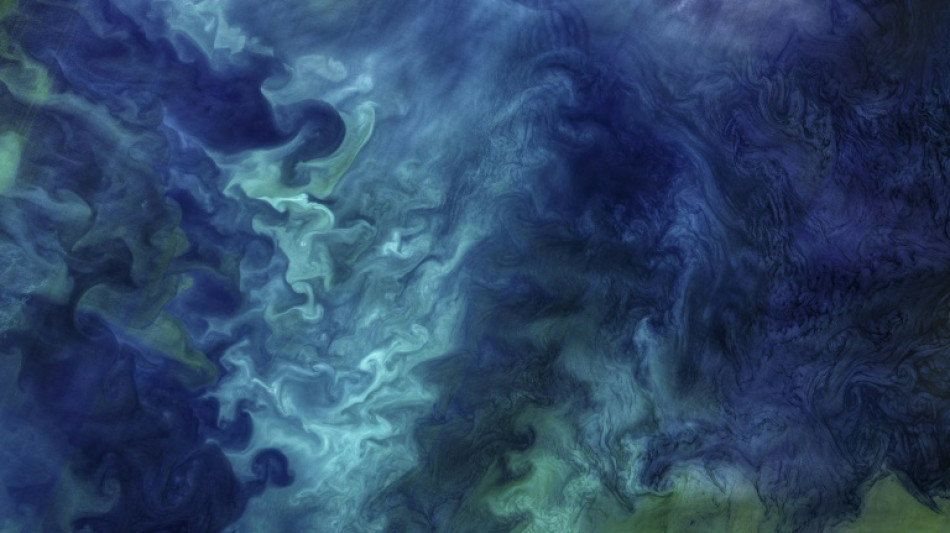
Oceans are changing colour and climate change may be to blame / Photo: HO - NASA/AFP/File

 Kenya's economy faces climate change risks: World Bank

 Crypto firm Tether bids for Juventus, is quickly rebuffed

 Can Venezuela survive US targeting its oil tankers?

 World stocks retrench, consolidating Fed-fuelled gains

 World stocks consolidate Fed-fuelled gains

 Stocks rally in wake of Fed rate cut

 British porn star to be deported from Bali after small fine

 Spain opens doors to descendants of Franco-era exiles

 Thai teacher finds 'peace amidst chaos' painting bunker murals

 South Korea exam chief quits over complaints of too-hard tests

 South Korea exam chief resigns after tests dubbed too hard

 Laughing about science more important than ever: Ig Nobel founder

 Crypto mogul Do Kwon sentenced to 15 years for fraud: US media

 Make your own Mickey Mouse clip - Disney embraces AI

 Dark, wet, choppy: Machado's secret sea escape from Venezuela

 2024 Eurovision winner Nemo returns trophy over Israel's participation

 Make your own AI Mickey Mouse - Disney embraces new tech

 Floodworks on Athens 'oasis' a tough sell among locals

 German growth forecasts slashed, Merz under pressure

 ECB proposes simplifying rules for banks

 Desert dunes beckon for Afghanistan's 4x4 fans

 Chocolate prices high before Christmas despite cocoa fall

 Asian traders cheer US rate cut but gains tempered by outlook

 Oracle shares dive as revenue misses forecasts

 Divided US Fed makes third straight rate cut, signals higher bar ahead

Over the past 20 years huge swathes of the world's oceans have changed colour, displaying a subtle greening towards the tropics that researchers say points to the effect of climate change on life in the world's seas.
In the new research published on Wednesday, scientists said they had detected shifts in colours across more than half of the world's oceans -- an expanse bigger than Earth's total land area.
Authors of the study in Nature think that is down to changes in ecosystems, and particularly in tiny plankton, which are the centrepiece of the marine food web and play a crucial part in stabilising our atmosphere.
"The reason we care about the colour changes is because the colour reflects the state of the ecosystem, so colour changes mean ecosystem changes," lead author B.B. Cael, of Britain's National Oceanography Centre, told AFP.
The colour of the seas when seen from space can paint a picture of what is going on in the upper layers of the water.
A deep blue would tell you that there is not much life, while if the water is greener it is likely to have more activity, specifically from the photosynthesising phytoplankton, which like plants contain the green pigment chlorophyll.
These produce a significant amount of the oxygen we breathe, are a crucial part of the global carbon cycle and are a foundational part of the ocean food web.
- Life colours -
Researchers are keen to develop ways of monitoring changes in ecosystems in order to track climate changes and enshrine protected areas.
But previous studies have suggested you would need three decades of ocean chlorophyll monitoring to detect a trend because of annual variations.
In the latest study, researchers broadened the colour spectrum, looking at seven hues of ocean colour monitored by the MODIS-Aqua satellite from 2002 to 2022.
These are too subtle for humans to see and would look largely blue to the naked eye.
The authors analysed the observational data to detect a trend above the year-to-year variability and then compared it to computer models of what would be expected with climate change.
They found that the real-world observations tallied closely with the changes predicted.
While the researchers said more work would be needed to find out what exactly those colour changes might mean, they said climate change was very likely to be the cause.
"I've been running simulations that have been telling me for years that these changes in ocean colour are going to happen," said co-author Stephanie Dutkiewicz, of MIT's Department of Earth, Atmospheric and Planetary Sciences at the Center for Global Change Science.
"To actually see it happening for real is not surprising, but frightening. And these changes are consistent with man-induced changes to our climate."
D.Avraham--CPN

