The 'kidneys of Kolkata': Indian wetlands under threat / Photo: DIBYANGSHU SARKAR - AFP

 Kenya's economy faces climate change risks: World Bank

 'Stop the slaughter': French farmers block roads over cow disease cull

 Why SpaceX IPO plan is generating so much buzz

 World stocks mostly slide, consolidating Fed-fuelled gains

 UK's king shares 'good news' that cancer treatment will be reduced in 2026

 Salah admired from afar in his Egypt home village as club tensions swirl

 Iran frees child bride sentenced to death over husband's killing: activists

 France updates net-zero plan, with fossil fuel phaseout

 EU agrees recycled plastic targets for cars

 British porn star fined, faces imminent Bali deportation

 Indonesia floods were 'extinction level' for rare orangutans

 Japan bear victim's watch shows last movements

 French indie 'Clair Obscur' dominates Game Awards

 Asian markets track Wall St record after Fed cut

 Vaccines do not cause autism: WHO

 'In her prime': Rare blooming of palm trees in Rio

 OpenAI beefs up GPT models in AI race with Google

 Cyclone causes blackout, flight chaos in Brazil's Sao Paulo

 US bringing seized tanker to port, as Venezuela war threats build

 Time magazine names 'Architects of AI' as Person of the Year

 OpenAI, Disney to let fans create AI videos in landmark deal

 Thyssenkrupp pauses steel production at two sites citing Asian pressure

 Stocks mixed as US rate cut offset by Fed outlook, Oracle earnings

 Breakout star: teenage B-girl on mission to show China is cool

 Austria set to vote on headscarf ban in schools

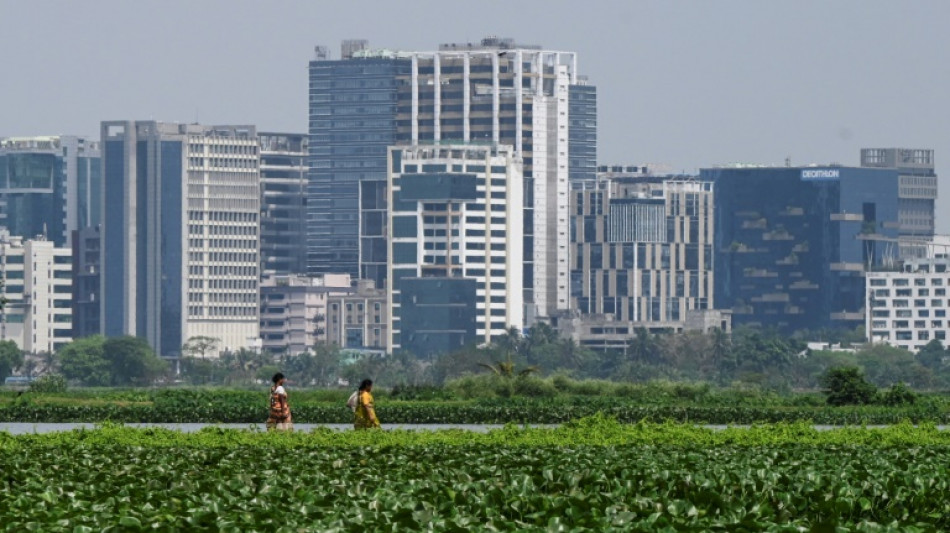
Wetlands just outside India's Kolkata have for generations provided tonnes of food daily and thousands of jobs as they filter sewage through fish ponds -- but rapid urbanisation is threatening the ecosystem.
Conservationists warn that pollution and strong-arm land grabs are putting a lifeline for the megacity's 14 million residents at risk.
"We are destroying the environment," said Tapan Kumar Mondal, who has spent his life farming fish in the ingenious system of canals and ponds stretching across about 125 square kilometres (48 square miles).
"The population... has increased, there is a pressure on nature, they are ruining it," 71-year-old Mondal added.
Listed as a wetland of global importance under the United Nations Ramsar convention, the waters offer natural climate control by cooling sweltering temperatures -- and act as valuable flood defences for low-lying Kolkata.
But Dhruba Das Gupta, from the environmental group SCOPE, said that short-sighted building development was encroaching on the wetlands.
"The wetlands are shrinking," said the researcher, who is trying to finance a study of what is left of the waters.
- 'Ecologically-subsidised city' -
Every day, 910 million litres of nutrient-rich sewage flow into the wetland, feeding a network of about 250 hyacinth-covered ponds.
"Sunlight and the sewage create a massive plankton boom," said K. Balamurugan, chief environment officer for West Bengal state, explaining that the microorganisms in the shallow fish ponds feed rapidly growing carp and tilapia.
Once the fish have had their fill, the water runoff irrigates surrounding rice paddies and the remaining organic waste fertilises vegetable fields.
"The sewage of the city is being naturally treated by the wetlands," Balamurugan said, giving them the nickname the "kidneys of Kolkata".
The community-developed system was created by "the world's foremost connoisseurs of wastewater wise use and conservation", according to its UN Ramsar listing, which also warns it is under "intense encroachment stress of urban expansion".
The late ecologist Dhrubajyoti Ghosh, who played a key role in the 2002 Ramsar submission, called Kolkata an "ecologically-subsidised city".
The wetlands system processes about 60 percent of Kolkata's sewage free of charge, saving the city over $64 million a year, according to a 2017 University of Calcutta study.
Farms in the wetlands provide about 150 tonnes of vegetables daily, 10,500 tonnes of fish annually and employ tens of thousands of people, the Ramsar listing estimates.
For Kolkata, on the vast delta where the Ganges River meets the Indian Ocean, the wetlands also provide flood defences for a city facing rising sea levels due to climate change.
"This city never faced any flooding issue," Balamurugan added. "These wetlands are acting as a natural sponge, taking the excess rainwater."
Das Gupta said the biodiversity hotspot also "plays a very important role in stabilising the climate", calling the wetlands "the lifeline of Kolkata".
"The wetlands have to stay, because of the cooling that they achieve by their very presence," she said.
- 'Land is being snatched' -
But the Ramsar listing notes that industrial effluent is tainting natural systems, threatening food production.
Fish farmer Sujit Mondal, 41, said that compared to last year "production has reduced" because of "murky water".
About 95 percent of the wetlands are in private hands.
As land prices surge, environment officials say they have pleaded with people not to fill in the fish ponds to create new building space.
"We asked them not to convert the wetlands, not to trade these wetlands to buildings, not to get them filled," Balamurugan said.
But residents say village councils are being bribed by land-hungry developers.
"They are often accused by residents of giving informal permission in return for money to real estate developers to build, while they look the other way," said Das Gupta.
"This leads to huge loss of productive space, and destroys the ecosystem services offered by these wetlands," she added.
"The land is being snatched from people," said Sujit Mondal, the fish farmer.
Gangs even net the ponds at night to steal the fish, leaving farmers with little option but to close and sell.
"They pressurise fishermen to give up their livelihoods," said Das Gupta. "Then they take control of the land."
H.Cho--CPN

