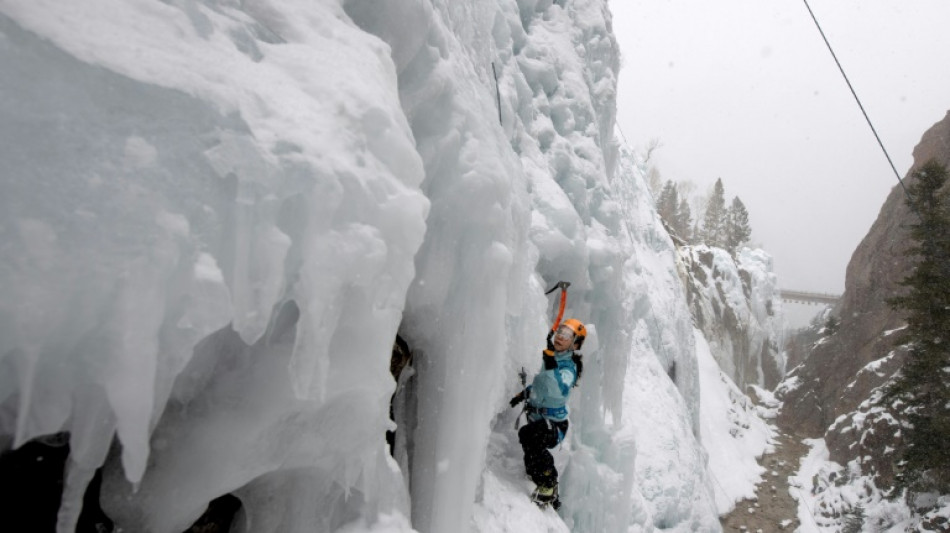
Ice park threatened by climate change finds an ally in US silver mine / Photo: Jason Connolly - AFP

 Kenya's economy faces climate change risks: World Bank

 'Stop the slaughter': French farmers block roads over cow disease cull

 Why SpaceX IPO plan is generating so much buzz

 World stocks mostly slide, consolidating Fed-fuelled gains

 UK's king shares 'good news' that cancer treatment will be reduced in 2026

 Salah admired from afar in his Egypt home village as club tensions swirl

 Iran frees child bride sentenced to death over husband's killing: activists

 France updates net-zero plan, with fossil fuel phaseout

 EU agrees recycled plastic targets for cars

 British porn star fined, faces imminent Bali deportation

 Indonesia floods were 'extinction level' for rare orangutans

 Japan bear victim's watch shows last movements

 French indie 'Clair Obscur' dominates Game Awards

 Asian markets track Wall St record after Fed cut

 Vaccines do not cause autism: WHO

 'In her prime': Rare blooming of palm trees in Rio

 OpenAI beefs up GPT models in AI race with Google

 Cyclone causes blackout, flight chaos in Brazil's Sao Paulo

 US bringing seized tanker to port, as Venezuela war threats build

 Time magazine names 'Architects of AI' as Person of the Year

 OpenAI, Disney to let fans create AI videos in landmark deal

 Thyssenkrupp pauses steel production at two sites citing Asian pressure

 Stocks mixed as US rate cut offset by Fed outlook, Oracle earnings

 Breakout star: teenage B-girl on mission to show China is cool

 Austria set to vote on headscarf ban in schools

America's ice-climbing epicenter was facing a bleak future, with climate change endangering its water supply, until an unlikely savior came to its rescue: a nearby silver mine.
Nestled in the heart of the Rockies, at an altitude of 2,400 meters (7,800 feet), Ouray is famous among mountaineers around the world for its artificial ice park.
For 30 years, the village has piped in water that washes down the walls of a nearby gorge in winter, freezing in place and creating dozens of climbing routes.
"It's definitely an ice climbing Mecca," said mountain guide Clint Cook.
"I can't think of anywhere else that attracts this many people specifically to one place, just for ice climbing."
But a damaging decades-long drought threatened the area's water source, even as the number of winter visitors exploded.
"I can remember some people going around town and be like 'Don't shower tonight! We need that water in the tank to build ice,'" said Cook, 47.
But starting next season, all that is set to change, after Ouray Silver Mines stepped in and offered to lease the rights to millions of liters (gallons) of water every year -- for a meager $1 fee.
"The water from the mine will give us anywhere from three- to five-times more water than we have access to right now," said Peter O'Neil, executive director of the nonprofit Ouray Ice Park.
"And we're not dependent on the city water tanks."
- 'Ghost town' -
That should secure the park's future not only for the "next generation of ice climbers," but also for all the local businesses that depend on tourists.
"If there was no ice park in the winter, the town would be a ghost town," said O'Neil.
"Most of the hotels and motels would be closed."
Ouray, a village of around 900 people, was founded in the 19th century during the Colorado Silver Rush -- a history that is commemorated by a statue of a miner found the town.
Silver mining dwindled over the 20th century, but renewed demand from new technologies like solar panels has reinvigorated the industry.
Brian Briggs, the former CEO of Ouray Silver Mines, who sealed the partnership transferring water rights to the ice park, said the alliance was a win for everyone.
Under Colorado's water use rights, the mine was entitled to millions of gallons for "recreational use," simply by dint of being a significant land owner.
It wasn't using them, and Briggs recognized the need to improve the image of his industry.
"Most people don't like things in their backyard that are mining or industrial," he said.
Donating the water, he figured, was a nice way to give back to the community in an effort to build good will.
"People need to know that the mine's not just this bad group of people," Briggs said.
- 'What if there's no ice?' -
Earth's warming climate, caused chiefly by humanity's unchecked burning of fossil fuels, has not only hit water supplies, but also causes problems with rising temperatures.
Ideally, the park needs several consecutive days where the temperatures stays below -7C (19 Fahrenheit) for the ice to form properly, hence the importance of being able to turn the taps on when the weather is right.
For the thousands of people who travel to the self-proclaimed "Switzerland of America" spending around $18 million a year, the deal is a real boost.
Jen Brinkley, from California, has been visiting Ouray almost every season for 30 years.
When she was younger, she said, she would ask: "How many times can we get up there this year? It was more about like, how many trips could we take?"
"There was never a thought of, 'oh, wait, what if there's no ice?'"
Brinkley hopes the water from the mine will secure the park's future and make the climbing there even better.
"With more routes open you definitely have people that can spread out and so everybody can have a chance to climb," she said.
P.Gonzales--CPN

