
Global warming is a security threat and armies must adapt: experts / Photo: JOSE JORDAN - AFP/File

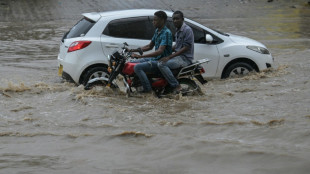 Kenya's economy faces climate change risks: World Bank

 Crypto firm Tether bids for Juventus, is quickly rebuffed

 Can Venezuela survive US targeting its oil tankers?

 World stocks retrench, consolidating Fed-fuelled gains

 World stocks consolidate Fed-fuelled gains

 Stocks rally in wake of Fed rate cut

 British porn star to be deported from Bali after small fine

 Spain opens doors to descendants of Franco-era exiles

 Thai teacher finds 'peace amidst chaos' painting bunker murals

 South Korea exam chief quits over complaints of too-hard tests

 South Korea exam chief resigns after tests dubbed too hard

 Laughing about science more important than ever: Ig Nobel founder

 Crypto mogul Do Kwon sentenced to 15 years for fraud: US media

 Make your own Mickey Mouse clip - Disney embraces AI

 Dark, wet, choppy: Machado's secret sea escape from Venezuela

 2024 Eurovision winner Nemo returns trophy over Israel's participation

 Make your own AI Mickey Mouse - Disney embraces new tech

 Floodworks on Athens 'oasis' a tough sell among locals

 German growth forecasts slashed, Merz under pressure

 ECB proposes simplifying rules for banks

 Desert dunes beckon for Afghanistan's 4x4 fans

 Chocolate prices high before Christmas despite cocoa fall

 Asian traders cheer US rate cut but gains tempered by outlook

 Oracle shares dive as revenue misses forecasts

 Divided US Fed makes third straight rate cut, signals higher bar ahead

From responding to weather disasters to rising competition in the fast-warming Arctic, militaries are exposed to climate change and cannot let it become a strategic "blind spot", security experts say.
Concerns have grown recently that climate action is being sidelined as Europe beefs up defence and the US retreats from allies and its green commitments.
But defence departments have already underscored that a warming planet poses major national security challenges, and militaries need to adapt to respond to these evolving threats.
"You can't escape this. Climate doesn't care who's president or what your political goals are at the moment," said Erin Sikorsky, director of the Washington-based Center for Climate & Security.
"It is coming, and militaries need to be prepared," she said.
In the US, where President Donald Trump's administration has scrubbed global warming from government websites, the latest intelligence threat assessment made no mention of climate change.
Sikorsky said this leaves crucial strategic gaps, particularly when it comes to renewable energy superpower China and the race for supremacy in the Arctic, where the loss of sea ice is opening up shipping lanes and access to resources.
"What I worry about, as someone who worked in national security for a long time, is this blind spot puts the US at risk," she said.
In Europe, Russia's invasion of Ukraine sparked energy security fears and accelerated many countries' renewables ambitions.
But in recent months countries have slashed international development aid, throwing climate budgets into question as spending priorities turn to defence and trade.
German Foreign Minister Annalena Baerbock last month acknowledged the "extremely challenging" geopolitical situation but insisted that climate action remained a "top security policy".
The country plans a half trillion dollar spending "bazooka" for military and infrastructure, coupled with 100 billion euros for climate measures.
-'Weaponising' disaster -
"Anyone thinking about security needs to think about climate as well. We are already living in the climate crisis," said an assessment commissioned by Germany's foreign and defence ministries in February.
It said climate challenges were emerging over "the entire range of military tasks", with increased risks including large-scale crop failures, conflict and instability.
In a September report, the UK's Ministry of Defense said humanity's impact on climate and the environment "continues to have far-reaching consequences, putting significant pressure on societies and economies and threatening the very existence of some states".
Militaries are increasingly being called in following floods, storms and wildfires, stretching the capacity of some forces, said Sikorsky, whose organisation has tracked more than 500 such emergency responses across the world since 2022.
There have also been efforts to "weaponise" climate disasters, she said.
Last year, torrential rains unleashed by Storm Boris caused massive flooding in Poland that swept away bridges, and destroyed homes and schools.
But as soldiers helped evacuate residents and clear debris, the government said it faced a 300 percent increase in Russian online disinformation, targeting the relief effort.
Sikorsky said China used the same "playbook" in the aftermath of deadly floods in Valencia, Spain, which also saw thousands of soldiers deployed.
Warming itself also has major operational implications.
Extreme temperatures can risk the health of soldiers and even reduce the amount of cargo that planes can carry, said Sikorsky.
- Energy vulnerabilities -
Militaries are not required to report their greenhouse gas emissions, so their direct contribution to global warming is not precisely known.
But a 2024 report by the European Union estimated the carbon "bootprint" of the world's armies could be 5.5 percent of global emissions.
The Pentagon alone produced more emissions than nations like Portugal or Denmark, the "Greening the Armies" report said.
Armies worried about fossil fuel dependence long before climate change became a priority -- concerns go back to the oil crisis in the 1970s, said Duncan Depledge from Loughborough University, who studies the implications of climate for militaries.
According to a 2019 study, the US army consumed about a gallon of fuel per soldier per day in World War Two. During the 1990-91 Gulf War it was around four gallons, and by 2006 it had surged to some 16 gallons in US operations in Iraq and Afghanistan.
A heavy reliance on fossil fuels creates "significant vulnerabilities" in combat, said the EU report.
Fuel convoys are an easy target for roadside bombs, which accounted for nearly half of American deaths in Iraq and close to 40 percent in Afghanistan, it said.
Renewable energy could help avoid these risks, the report said, but acknowledged the technology was "not yet entirely suitable for combat".
Depledge said a faster global energy transition to avert "climate catastrophe" would pose challenges for armies, likely raising concerns over their fossil fuel use.
"Whichever direction you go, militaries no longer have a choice about the fact that they're going to be operating in a very different world to what they do today," he said.
C.Peyronnet--CPN

